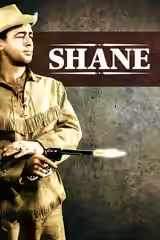
The critic calls Shane a revelation and one of the finest American motion pictures, a marvellous distillation of Hollywood cinema with personal and universal vision. The Technicolor photography, editing, Alan Ladd's performance, Jean Arthur's understated role, and Victor Young's score are singled out for praise.
Ebert views the film as a complex work with multiple layers beyond a simple morality play about homesteaders versus cattlemen, including psychological depths in the title character. He singles out Alan Ladd's nuanced performance and the film's visual and emotional richness for particular praise.
The review hails 'Shane' as a magnificent and rich Western that captures the bitterness of frontier feuds with stunning Technicolor cinematography and strong performances. It particularly praises the direction, scenic grandeur, and young Brandon de Wilde's scene-stealing turn.
The review praises the film as a socko, non-conventional Western drama with tremendous integrity in direction and casting that delivers both class and mass appeal. It highlights Stevens' measured handling, the standout performances especially by Ladd and de Wilde, and the breathtaking Technicolor photography.
The film is seen through a child's eyes as Shane idolises the mysterious gunslinger at the expense of his own father. Director George Stevens excels with the landscape and a hymn-like stump-pulling scene, while strong supporting turns from Jean Arthur and others stand out, though Alan Ladd's wooden lead performance and the film's overreaching classic ambitions are noted as drawbacks.
The critic views Shane as a classic that subtly undermines traditional masculinity through its protagonist’s sensitive yet strong demeanor, contrasting it with more rigid male archetypes. She singles out the film’s exploration of psychological frontiers and Shane’s quiet kindness alongside his refusal to engage in macho posturing.
The critic praises Shane as a classic Western that captured the shifting postwar American mood, marking a transition toward more complex and ambiguous heroes. The family dynamic at the film's heart, including the boy's idolization and the unspoken attraction between Shane and the wife, is singled out as its real crux.
McCarten calls 'Shane' a first-rate, old-fashioned Western with persuasive direction and emotional moments, though he questions the conventional glorification of homesteaders over cattlemen. He notes Stevens' skill in handling action and character while preferring to enjoy it as straightforward entertainment.
The review notes the film's inflated reputation and self-conscious landmark status, criticizing its slow pace and solemnity that reduce tension. The splendid cast and well-handled emotional tensions and final confrontation are singled out for praise.
Praises it as one of the best Westerns ever made, shockingly gorgeous with sumptuous vistas and alluring imagery. Highlights its influence on later films, the impactful loud gunshots dramatizing violence's cost, the tragic stoic hero, and the masterful climactic speech about killing as an irreversible brand.
The critic sees why people love it but finds it a well-crafted but slight and unfulfilling piece of corn, best appreciated by young boys of the 1950s. It praises the noble masculinity concept and the famous ending but notes its limitations as ultimately unfulfilling.
Ordered by the weight we give each publication, then by score. Scores are normalised to 100; * means inferred from an unrated review. Summaries are ours, not quotations; follow the links for the reviews themselves. How we rate