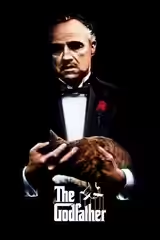
The consensus is strongly positive, with praise clustering around the performances, the family drama and the film’s account of American power. Most critics single out Marlon Brando’s authority as the Don, while Al Pacino and the ensemble receive sustained attention. The reviews admire how Coppola makes the Corleones’ enclosed world compelling without losing sight of its brutality. The dark photography and careful establishment of period and mood also earn praise, alongside readings that connect organised crime to capitalism and respectable institutions.
Reservations concern length and clarity rather than the film’s central achievements. Variety finds it overlong and occasionally confusing, while Sight and Sound questions both its length and its self-effacing style. Other reviews praise its control across the long running time. The spread is narrow in sentiment: even the more qualified accounts admire the acting, with disagreement chiefly about how effectively the sprawling family story holds together.
T
Time Out
21 September 2024 · ★★★★★ · Tom Huddleston
100
The film is the single most financially successful movie to date and remains almost universally beloved, appearing in the top rank of best movie lists. It is grand entertainment as well as an emotional and intellectual experience, with a Shakespearean story, striking black and autumnal brown photography, shocking violence and flawless performances.
Read the full review →E
Empire
24 August 1972 · Kim Newman
90*
The critic views it as marking the dawn of the mega-movie era, transitioning organized crime while blending art and commercial appeal. They praise its performances, style, substance, and how it achieves box office success without being mindless, noting it has aged better than most films from the early 1970s.
Read the full review →E
Evening Standard
10 April 2012
90*
The original Godfather stands as a near-perfect example of classical filmmaking and a generational saga. It features superb performances, a tight grip over its long runtime and darkly ironic commentary.
Read the full review →R
RogerEbert.com
16 March 1997 · Roger Ebert
90*
Ebert praises the film for inviting viewers to consider the Mafia entirely on its own terms within a closed world, making even evil characters sympathetic. He singles out the virtuoso filmmaking in introducing the large cast and Gordon Willis' rich, atmospheric cinematography for praise.
Read the full review →A
The AV Club
4 October 2019 · Tom Breihan
90*
The critic highlights the film's indictment of American capitalism and corruption through Michael Corleone's arc and iconic scenes like the baptism montage. It is celebrated as a mythic, operatic masterpiece that remains compelling and rewatchable.
Read the full review →H
The Hollywood Reporter
15 March 1972 · Arthur Knight
90*
The critic finds the film an extraordinary achievement that successfully adapts the novel while delivering a richly detailed epic of family, power, and crime. Particular praise goes to Marlon Brando's transformative performance as the aging don and the seamless ensemble interplay among the cast.
Read the full review →G
The Guardian
25 September 2009
80*
The critic views Coppola’s 1972 film as a measured, deathly serious epic that offers a top-down view of the mafia. Brando’s authoritative performance as the Don is singled out for its papal quality and lasting influence on the genre.
Read the full review →S
Sight and Sound
1 September 1972
The review notes the film's self-effacing style and length as drawbacks but highlights its compelling portrayal of contemporary private enterprise through strong performances, particularly Marlon Brando as the Don and Al Pacino as Michael.
Read the full review →N
The New Yorker
18 March 1972 · Pauline Kael
The film merges commerce and art, staying close to the book's sensationalism while achieving spaciousness and strength. It offers a vivid view of a Mafia dynasty with Coppola's quality of feeling, headed by marvelous performances from Brando, Caan and Pacino.
Read the full review →N
The New York Times
16 March 1972 · Vincent Canby
Canby calls it one of the most brutal and moving chronicles of American life ever designed within popular entertainment, a superb Hollywood movie that transcends its milieu. He singles out Marlon Brando's magnificent performance as the shrewd patriarch and the film's capture of the Corleone family's isolated world for praise.
Read the full review →V
Variety
7 March 1972 · A.D. Murphy
Murphy notes the large pre-sold audience, outstanding performance by Al Pacino, strong characterization by Marlon Brando, excellent production values, flashes of excitement, and a well-picked cast. He singles out the establishment of mood and time as the biggest achievement but complains that the film is overlong and occasionally confusing.
Read the full review →E
Eye for Film
24 December 2006 · Chris
90*
The critic calls it a masterpiece of restrained filmmaking that elevates the gangster genre with traditional storytelling freed from censorship. They single out the complex family plots as potentially overwhelming for first-time viewers while praising the contrasts between light and dark and the characters' dual natures.
Read the full review →C
Collider
23 December 2022 · B+ · Emily Bernard
83
The critic calls it a movie you can't refuse and praises its ensemble cast, storytelling scope, and Al Pacino's gradual transformation into a ruthless figure as the standout element.
Read the full review →P
The Playlist
15 March 2022 · Jason Bailey
Coppola uses the film's opening to explore the gap between American ideals and realities, with the Don's world revealing how power trumps justice or morality in a nation where lofty principles often fail. The story underscores that respectable institutions like police and politicians are no better than criminals, highlighting the film's quintessentially American focus on raw power and the illusion of the American Dream.
Read the full review →Ordered by the weight we give each publication, then by score. Scores are normalised to 100; * means inferred from an unrated review. Summaries are ours, not quotations; follow the links for the reviews themselves. How we rate