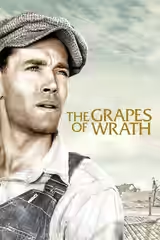
Critics’ reviews

The Grapes of Wrath (1940)

12 reviews from 12 publications. Critics’ score 84: 12 positive, 0 mixed, 0 negative.

Back to our review of The Grapes of Wrath

84
Positive
12
Mixed
0
Negative
0

Every one of the twelve reviews is positive, and the praise gathers in the same three places. Gregg Toland’s photography is mentioned by almost everyone, usually for the way it finds beauty in dust and lamplight without prettifying the poverty. Henry Fonda’s Tom Joad and Jane Darwell’s Ma Joad are singled out again and again, and John Ford’s direction is credited with keeping familiar material moving at pace. Empire goes as far as calling it his best film outside the Westerns, and the reviews written on release treat it as a classic on arrival.

The reservations are small and consistent. Several critics, Radio Times and Slant among them, feel the film softens Steinbeck’s politics, swapping the novel’s anger for religious symbolism and pity. Roger Ebert makes a similar point and is the coolest of the twelve. The Guardian finds the rhythm jerky in places and some of the dialogue stiff. Nobody, though, argues against seeing it.

Radio Times
★★★★★ · Adrian Turner
100

This is a magnificent adaptation of Steinbeck's novel, with heart-rending scenes and lasting power in the migrants' fate, though it substitutes corny religious symbolism for the novel's raw politics. It is beautifully photographed by Gregg Toland, with standout performances including Jane Darwell as Ma Joad.

Read the full review →
Empire
1 January 2000
90*

The critic calls it John Ford's best non-Western and possibly his best film overall. Praise goes to Henry Fonda's performance as Tom Joad and Gregg Toland's cinematography capturing the American landscape, alongside Ford's sympathetic take on workers' rights.

Read the full review →
The New Yorker
27 January 1940 · John C. Mosher
90*

The critic hails the film as an epic of starvation sustained with majesty that never falters, crediting John Ford’s swift pacing and fresh handling of familiar material. It singles out the script’s success, the landscape’s grandeur, and the ensemble performances for praise.

Read the full review →
The New York Times
25 January 1940
90*

The review deems the film a flawless screen edition of Steinbeck’s novel that follows the book closely yet intelligently, with uniformly excellent and suitable performances. It praises the direction, adaptation, and overall execution as adding the picture to the shelf of screen classics.

Read the full review →
Variety
30 January 1940 · John C. Flinn Sr.
90*

The review calls the picture an absorbing, tense melodrama that is starkly realistic and loaded with social and political fireworks, crediting Ford’s courage and skill. It praises the casting (especially Fonda, Darwell, and Carradine) and the convincing treatment of the American social problem.

Read the full review →
The Telegraph
11 August 2021 · Simon Heffer
80*

The piece examines how the 1940 John Ford film captured the essence of the Great Depression and shocked audiences with its portrayal of exploitation and hardship faced by the Joad family. It highlights the film's enduring relevance to themes of economic injustice and migration.

Read the full review →
Time Out
10 September 2012 · MH
80*

Ford's adaptation captures the stark plainness of the migrants' journey and struggles during the Depression. The film is shot by Gregg Toland with magnificent, lyrical simplicity.

Read the full review →
Slant Magazine
23 November 2010 · Chuck Bowen
75*

The critic finds Ford's adaptation a major achievement despite some dated lapses and softening of the novel's politics, praising its vivid depiction of Depression-era poverty and masterful direction contrasting with Toland's lighting. He singles out the performances of Fonda and Darwell and powerful scenes for their emotional impact.

Read the full review →
The Guardian
17 July 1940
75*

The critic praises the film's authentic depiction of the Okies' suffering and the excellent casting and acting, particularly noting John Ford's recognition of visual opportunities in the dust-bowl and journey sequences. It criticizes the jerky rhythm and occasional stiffness of dialogue compared to Stagecoach, but overall recommends the film as essential viewing.

Read the full review →
RogerEbert.com
31 March 2002 · Roger Ebert
70*

Ebert calls the film a left-wing parable about a sharecropper’s son converted into a union organizer, told through sympathetic characters and images of beauty that evoke pity rather than anger. He singles out Henry Fonda’s Tom Joad, Jane Darwell’s Ma Joad, Gregg Toland’s low-light cinematography, and John Ford’s rigorous visual style for particular praise.

Read the full review →
The Playlist
7 July 2015 · The Playlist Staff
85*

The piece hails the film as Ford’s Oscar-winning monumental work, an almost indecently beautiful yet realist picture that serves as the definitive cinematic take on America’s Great Depression, praising Henry Fonda’s nuanced performance and the breadth of its ambition despite some speechifying.

Read the full review →
Eye for Film
25 January 2018 · Jennie Kermode
80*

The critic finds the film watchable and highly effective despite its age, praising its engaging portrayal of the Great Depression era and the human spirit, though noting it is more optimistic than the source novel. They single out Gregg Toland's cinematography and John Ford's direction for bringing the landscapes and family dynamics to life.

Read the full review →

Ordered by the weight we give each publication, then by score. Scores are normalised to 100; * means inferred from an unrated review. Summaries are ours, not quotations; follow the links for the reviews themselves. How we rate