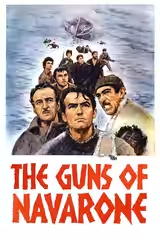
Critics’ reviews

The Guns of Navarone (1961)

9 reviews from 9 publications. Critics’ score 69: 6 positive, 0 mixed, 3 negative.

Back to our review of The Guns of Navarone

69
Positive
6
Mixed
0
Negative
3

Most critics like it, and they like it for the same reasons. The praise gathers around the set pieces: the cliff climb, the storm and the final assault are singled out as the sequences that still work. The cast gets the next share of credit, with Gregory Peck, Anthony Quinn and David Niven named again and again, and several reviews credit J Lee Thompson with holding the tension across a long running time. Dimitri Tiomkin’s score is mentioned warmly more than once.

The spread is wide, though. Three of the nine are negative, and the dissenters agree on the problem: the film wants to be an adventure and an argument about the futility of war, and the two pull against each other. Sight and Sound finds too much talk and thinks Niven miscast; The Guardian calls it a pantomime with wooden acting. Even The New York Times, broadly favourable, wants more character and less melodrama.

Slant Magazine
7 May 2007
90*

The film ranks among the best war movies for its mayhem, fighting, and straightforward story of heroism. It survives on its strong performances, particularly those of Gregory Peck, Anthony Quinn, and David Niven, and its sense of being more than a product of its time.

Read the full review →
The Telegraph
5 November 2021
90*

The piece celebrates the film as a groundbreaking epic that set standards for special effects, star power and stunt work in war movies. It highlights its enduring excitement and status as a blockbuster success that influenced later ensemble war films.

Read the full review →
Variety
31 December 1960 · Variety Staff
90*

The film is a winner thanks to its weighty stars, terrific special effects and socko situations, despite a mid-production director switch and high cost. Highlights include the cliff-scaling sequence, storm scene and explosive climax.

Read the full review →
Empire
27 April 2006 · Ian Nathan
80*

The critic views the film as a quintessential WWII men-on-a-mission adventure that thrillingly executes its high-stakes plot with strong performances from a mix of actors and real directorial skill in building tension. It is described as a boy's-own classic despite being out of fashion.

Read the full review →
Radio Times
· Jeremy Aspinall
80*

This classic wartime adventure follows a daring commando raid on German guns threatening naval operations, with strong support from a cast including Gregory Peck, Anthony Quinn and David Niven. Director J Lee Thompson maintains tension across the epic length, aided by a stirring Dimitri Tiomkin score.

Read the full review →
The New York Times
23 June 1961 · Bosley Crowther
70*

This big, robust action drama in the DeMille tradition emphasizes melodrama over character or credibility but moves swiftly with pace and bold performances. The director handles the explosive action well, though the producer might have aimed for more complex human drama.

Read the full review →
Sight and Sound
40*

The film struggles with an imbalance between its moral and philosophical themes and the adventure plot, resulting in too much talk and diffusion that undermines narrative tension. Gregory Peck's impassive performance and miscasting of David Niven add to the difficulties in accepting the characters' relationships.

Read the full review →
The Guardian
15 May 1961
30*

The critic finds the film a boys' own adventure pantomime that fails to convey its intended anti-war message about the futility of conflict. The acting is criticised as wooden, though it works as straightforward old-fashioned adventure.

Read the full review →
Den of Geek
17 October 2011 · ★★ · Mark Pickavance
40

The critic grew up loving 1960s war movies but now appreciates this one's subversion of the genre through character tensions and anti-war undertones beneath the action. He singles out the strong ensemble cast, especially the dynamics among Peck, Niven and Quinn, and the evocative score for praise.

Read the full review →

Ordered by the weight we give each publication, then by score. Scores are normalised to 100; * means inferred from an unrated review. Summaries are ours, not quotations; follow the links for the reviews themselves. How we rate