Critics’ reviews

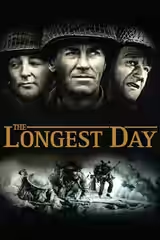
The Longest Day (1962)

7 reviews from 7 publications. Critics’ score 64: 3 positive, 2 mixed, 2 negative.

Back to our review of The Longest Day

64
Positive
3
Mixed
2
Negative
2

Most critics come down mildly in favour, and what they agree on is the size of the thing. The reviews praise the scale of the D-Day recreation, the well-staged battle sequences and the decision to tell the story from several national viewpoints at once. The newsreel-style black-and-white photography and the enormous cast are singled out more than once, and several critics find the combat as effective as anything in later war films.

The reservations cluster around people rather than spectacle. Most critics find the characters thin, the vignettes between battles heavy-handed and the national stereotypes crude, and almost everyone thinks it too long. The spread is wide, from warm to hostile. The New Yorker finds it technically impressive but emotionally distant and, finally, dull, and Eye for Film thinks the parade of star cameos and a disjointed structure sink its grand intentions. Radio Times, though positive, also complains of overacting from the European players.

Variety
31 December 1961
85*

The review praises the film as a solid and stunning war epic that details the D-Day landings through personal vignettes and big battles, emerging as an effective grand-scale semi-fictionalized documentary. It highlights the capture of war's savage fury and the massive action sequences as standout elements.

Read the full review →
Radio Times
★★★★ · Allen Eyles
80

The epic benefits from its huge budget, star power, military cooperation and innovative multi-national viewpoint structure, enhanced by newsreel-style black-and-white photography and well-staged battles. It is undermined by overacting from many European performers, crude characterisation and pretentious vignettes.

Read the full review →
Empire
1 January 2000 · Clark Collis
75*

The critic describes the film as a heartfelt recreation of the D-Day landings that is every bit as memorable as more modern depictions, despite its length, and praises its epic scope and impressive cast.

Read the full review →
The AV Club
17 May 2019 · Tom Breihan
60*

The critic notes that the war itself is the star of this impersonal epic, praising its scale and multi-perspective approach but complaining about the lack of memorable characters and how it has dated compared to later war films.

Read the full review →
Time Out
10 September 2012 · GA
60*

The film stands as one of the last true war epics thanks to its massive scale, all-star cast and source material. It delivers spectacle, heroism and some humour but is hampered by excessive length and heavy-handed national stereotypes.

Read the full review →
The New Yorker
6 October 1962 · Brendan Gill
40*

The critic views the film as a technically impressive but emotionally distant reconstruction of D-Day that fails to engage as art and leaves the viewer bored despite its spectacle. He singles out the excessive use of fleeting star cameos as a distracting element that undermines seriousness.

Read the full review →
Eye for Film
2 July 2004 · Scott Macdonald
40*

The critic finds that the film crumbles under its own epic intentions and lack of cohesion, despite its comprehensive scope and attention to detail in depicting the D-Day events. They single out the effectively staged combat scenes and visual impact of the widescreen photography for praise, while criticizing the disjointed narrative, excessive star cameos, and overlong exposition.

Read the full review →

Ordered by the weight we give each publication, then by score. Scores are normalised to 100; * means inferred from an unrated review. Summaries are ours, not quotations; follow the links for the reviews themselves. How we rate