Film review

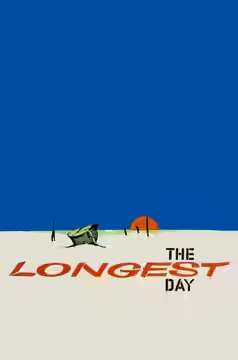
The Longest Day

1962 · Directed by Ken Annakin, Bernhard Wicki, Andrew Marton · 2h 58m · MPA PG

In a sentenceThree hours, three directors, and every famous man of 1962 in a helmet; the war still wins

WarActionDrama

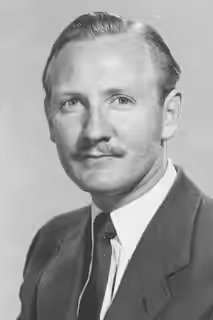
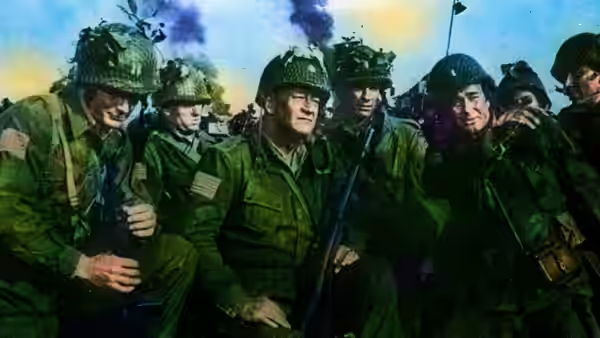
Normandy and the south of England, June 1944. The Allied invasion of occupied France has already been postponed once for weather, and everyone is waiting for the order. Lt. Col. Benjamin Vandervoort (John Wayne) briefs his paratroopers. Brig. Gen. Norman Cota (Robert Mitchum) and Brig. Gen. Theodore Roosevelt Jr. (Henry Fonda) prepare to go ashore with the infantry. Lord Lovat (Peter Lawford) readies his commandos, piper included. Across the Channel, Maj. Gen. Dr. Hans Speidel (Wolfgang Büttner) and the rest of the German staff study the same skies and decide nobody would attack in this. The BBC broadcasts coded verse to the French Resistance. Then the weather breaks for a few hours, the order is given, and the film follows the landings by sea and by air, in English, French and German.

Fi1m review

Darryl F. Zanuck’s three-hour, three-director account of D-Day is a serious, handsome film that shows the size of the day as few films have, and it fills the beaches with famous faces until hardly anyone on them is a person.

Darryl F. Zanuck’s account of 6 June 1944 is three hours long, was shot by three directors, and puts most of the famous men of its year into uniform. It comes from Cornelius Ryan’s book and keeps the book’s method: no hero, no single thread, dozens of people on both sides of the Channel getting through the same day. It is a large, serious, handsomely made film, and almost nobody in it matters as a person. We admired it for most of its 178 minutes and were moved by it for perhaps ten.

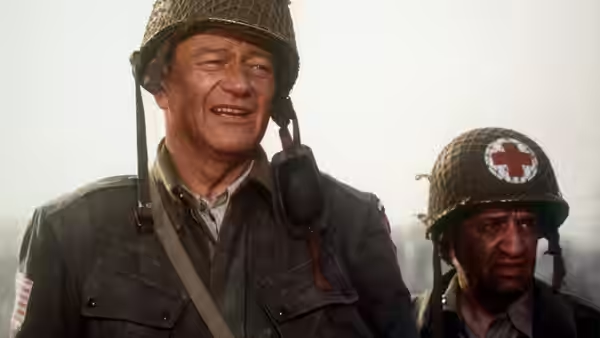
The first hour is the waiting. Along the Atlantic Wall the German staff, Wolfgang Büttner’s Speidel among them, look at the weather and decide nobody would be fool enough to come. In England the paratroopers black their faces and Lt. Col. Vandervoort (John Wayne) briefs his men. The BBC reads poetry to the French Resistance. Ken Annakin directs the British, Andrew Marton the Americans, Bernhard Wicki the Germans, and the Germans speak German and the French speak French, with subtitles. In 1962 that was not the usual thing, and it still gives the film a seriousness the casting keeps trying to undo.

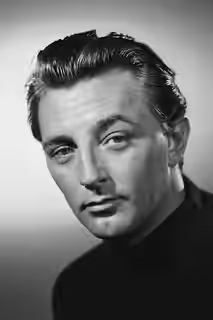
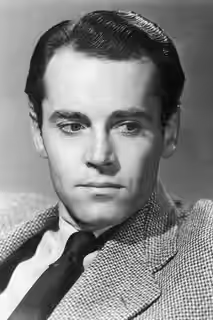
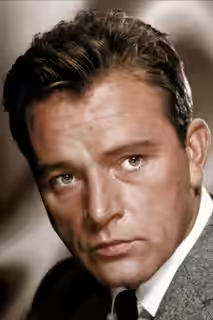
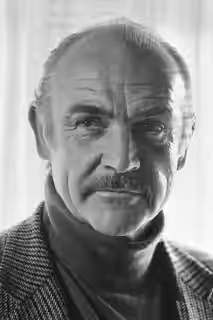
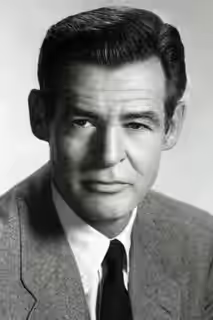
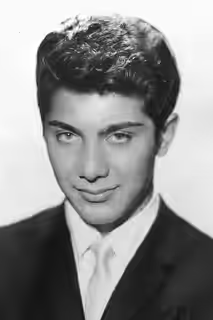
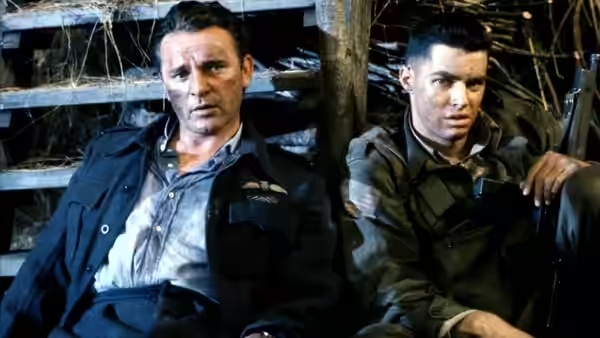
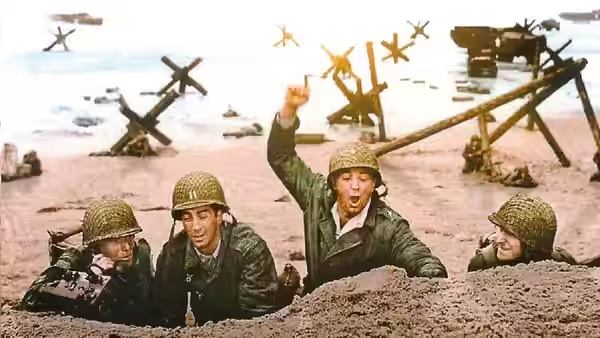
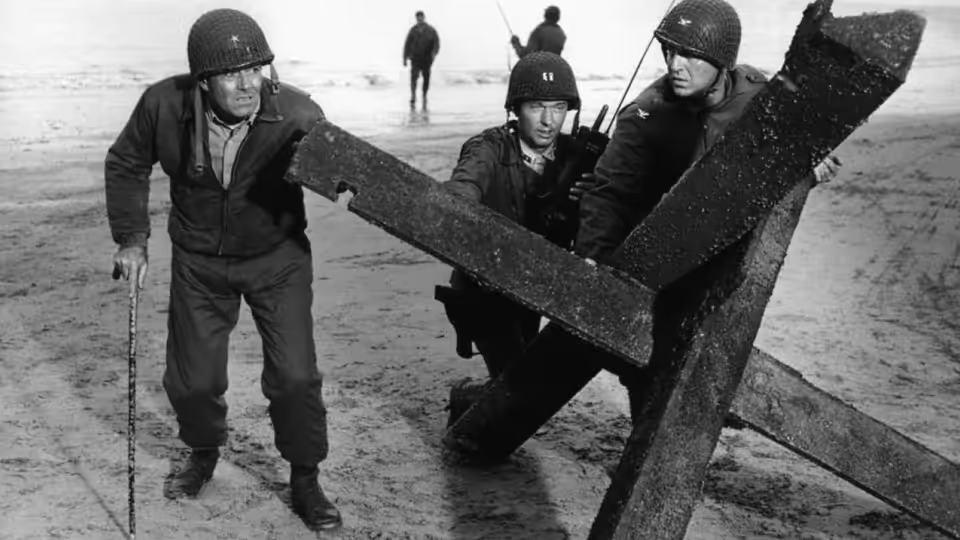
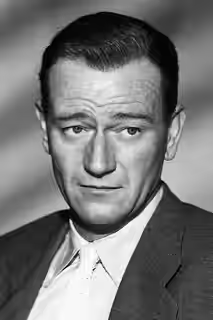
The casting is the problem. Wayne plays a lieutenant colonel of paratroops and moves like a man who has never been asked to jump out of anything. Robert Mitchum’s Brig. Gen. Cota chews a cigar on Omaha Beach and is good, because Mitchum was always good at appearing not to try. Henry Fonda plays Theodore Roosevelt Jr. with a cane and a decency that gets about four minutes. Then Richard Burton turns up as a downed pilot, Sean Connery grins his way through a turn as an Irish private, Peter Lawford leads his commandos ashore behind a piper, and Paul Anka is a Ranger for reasons that must have made sense to somebody. We kept spotting people, and every time we spotted one the film stopped being about the war and became a parade.

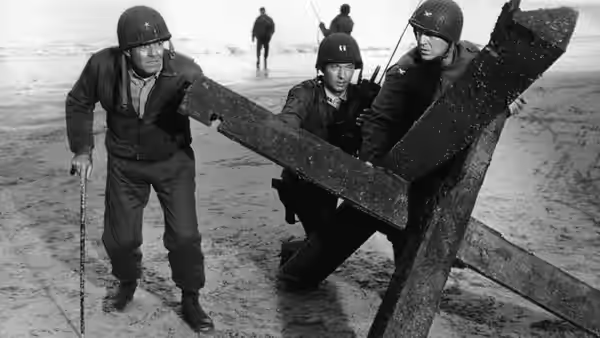
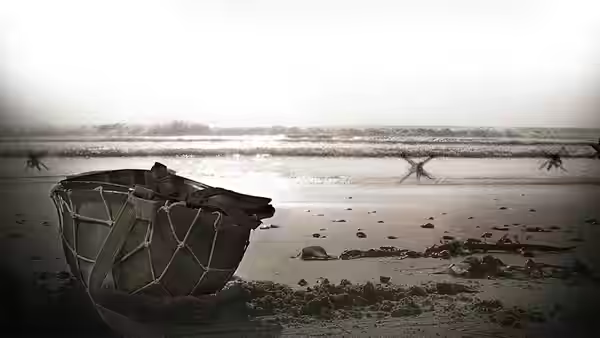
The spectacle is another matter. Walter Wottitz and Jean Bourgoin shoot in black and white in a flat grey light that lets the staged footage sit beside the real thing without a join, and the beaches look cold and huge and empty of cover. The assault on the casino at Ouistreham is done in one long shot from above, the camera drifting along the canal as the French commandos run under fire, and it is the best-directed minute in the film. The Rangers going up the cliffs at Pointe du Hoc on ropes, while the ropes are cut above them, is nearly as good. Samuel E. Beetley cuts between the fronts fast enough that the film never sits still, though he cannot make forty people into a story. Maurice Jarre’s march is heard less than you might expect; the beaches are mostly given surf and gunfire.

The moment that got us was smaller. A paratrooper’s canopy catches on the church steeple at Sainte-Mère-Église and he hangs there, playing dead, while the square below him is shot to pieces and the bell drowns everything, and he can only watch. It is the one place where the film lets a man be frightened long enough for us to be frightened with him. It lasts perhaps three minutes and we would have given up several generals for more of it.

By the third hour we had stopped feeling anything much and were keeping count. Every landing is introduced with a name card, every officer explains the plan to a subordinate who already knows it, and the German high command gets more time to be wrong than any private gets to be scared. Cornelius Ryan wrote the screenplay from his own book, with David Pursall, Jack Seddon, Romain Gary and James Jones also credited, and the result has the completeness of a report and the flatness of one.

Against the war films that came after, it has dated the way a well-kept monument dates. Other films have shown us how frightening the day was; this one shows us how big it was, and that is worth something. See it in a cinema if one will show it, where the beaches are the right size and the roll call is easier to forgive. At home it is an afternoon rather than an evening, and it wants a companion who knows which beach is which.
Critical consensus AI synthesised

64
Positive
3
Mixed
2
Negative
2

Most critics come down mildly in favour, and what they agree on is the size of the thing. The reviews praise the scale of the D-Day recreation, the well-staged battle sequences and the decision to tell the story from several national viewpoints at once. The newsreel-style black-and-white photography and the enormous cast are singled out more than once, and several critics find the combat as effective as anything in later war films.

The reservations cluster around people rather than spectacle. Most critics find the characters thin, the vignettes between battles heavy-handed and the national stereotypes crude, and almost everyone thinks it too long. The spread is wide, from warm to hostile. The New Yorker finds it technically impressive but emotionally distant and, finally, dull, and Eye for Film thinks the parade of star cameos and a disjointed structure sink its grand intentions. Radio Times, though positive, also complains of overacting from the European players.

Variety
31 December 1961
85*

The review praises the film as a solid and stunning war epic that details the D-Day landings through personal vignettes and big battles, emerging as an effective grand-scale semi-fictionalized documentary. It highlights the capture of war's savage fury and the massive action sequences as standout elements.

Read the full review →
Radio Times
★★★★ · Allen Eyles
80

The epic benefits from its huge budget, star power, military cooperation and innovative multi-national viewpoint structure, enhanced by newsreel-style black-and-white photography and well-staged battles. It is undermined by overacting from many European performers, crude characterisation and pretentious vignettes.

Read the full review →
Empire
1 January 2000 · Clark Collis
75*

The critic describes the film as a heartfelt recreation of the D-Day landings that is every bit as memorable as more modern depictions, despite its length, and praises its epic scope and impressive cast.

Read the full review →
The AV Club
17 May 2019 · Tom Breihan
60*

The critic notes that the war itself is the star of this impersonal epic, praising its scale and multi-perspective approach but complaining about the lack of memorable characters and how it has dated compared to later war films.

Read the full review →
Time Out
10 September 2012 · GA
60*

The film stands as one of the last true war epics thanks to its massive scale, all-star cast and source material. It delivers spectacle, heroism and some humour but is hampered by excessive length and heavy-handed national stereotypes.

Read the full review →
The New Yorker
6 October 1962 · Brendan Gill
40*

The critic views the film as a technically impressive but emotionally distant reconstruction of D-Day that fails to engage as art and leaves the viewer bored despite its spectacle. He singles out the excessive use of fleeting star cameos as a distracting element that undermines seriousness.

Read the full review →

Cast

Awards

Academy Awards, 1963

Nominated
Best Art Direction, Black and White
Nominated
Best Film Editing
Nominated
Best Picture
Won
Best Cinematography, Black-and-White
Won
Best Special Effects

Silver nugget for the best foreign film, 1963

Won
Silver nugget for the best foreign film

If you liked this, try…

A Bridge Too Far poster

A Bridge Too Far

1977 · Cornelius Ryan’s other book, filmed the same way, with a defeat instead of a landing

Saving Private Ryan poster84

Saving Private Ryan

1998 · Omaha Beach again, this time from inside one terrified man’s helmet

Tora! Tora! Tora! poster

Tora! Tora! Tora!

1970 · Pearl Harbor from both sides, with the same patience and the same lack of heroes

Das Boot poster89

Das Boot

1981 · The German war as the Germans lived it, in one submarine, for months

The Big Red One poster

The Big Red One

1980 · Samuel Fuller was on those beaches and filmed them small, rough and personal