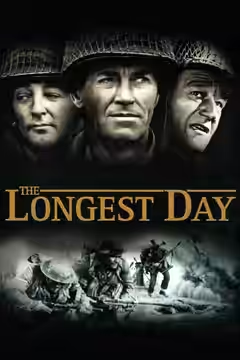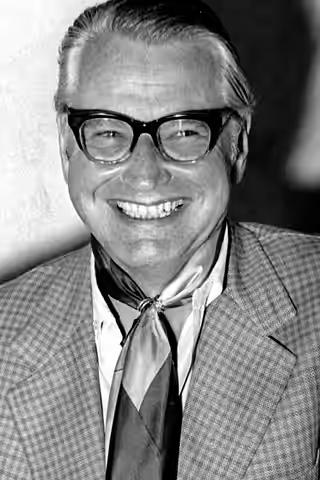
Ken Annakin could put a hundred famous men and a dozen aeroplanes on screen and keep them all in order. He seldom made us look at any one of them for long, which is why The Longest Day impresses more than it moves.
Fi1m perspective
In The Longest Day (1962) the BBC reads poetry over the wireless to the French Resistance. It is a small scene in a three-hour film, and it is the sort of thing Ken Annakin did well: people who know their job, and no fuss. He directed the British and French sequences of Darryl F. Zanuck's account of D-Day, with Andrew Marton on the Americans and Bernhard Wicki on the Germans, and the Germans speak German and the French speak French, with subtitles. In 1962 that was not the usual thing, and it is still the main reason the film feels serious.
He had come to features from documentaries and training films for the RAF Film Unit and the Ministry of Information, and the documentary habit stayed with him. Holiday Camp (1947), his first feature, for Gainsborough and the producer Sydney Box, gave Britain the Huggett family and a run of comedies about them. In the 1950s he worked for Disney's British operation, and Swiss Family Robinson (1960) came of it: a family adventure shot on location with practical effects. Then the 1960s got large. The Longest Day was followed in 1965 by Battle of the Bulge and by Those Magnificent Men in Their Flying Machines, written with Jack Davies, a comedy built around a race and a great many aircraft. After one more race with another crowd, in 1969, the pictures shrank: The Call of the Wild (1972), and children's films into the 1980s.
The Normandy film shows what he was for. It shows the size of the day as few films have, and much of that is his: the first hour is the waiting, and we were more held by it than we expected to be, because it is content to watch competent men wait. The trouble is what happens when the waiting ends. Zanuck fills the beaches with famous faces until hardly anyone on them is a person, and Annakin, who liked a crowd, was never the man to argue for fewer people in the frame. The casting keeps undoing the seriousness the languages built, and that is why the film is decent rather than good.
He said, "I make films for audiences", and did not mean it as an apology. The film he named as his own favourite was Across the Bridge (1957), a Graham Greene adaptation with one man at its centre, which says something about what the big pictures cost him. There is no single Annakin film we would send a stranger to. There is a long shelf of them that do what they set out to do, which is fill an afternoon and keep the traffic moving. Start with the first hour of The Longest Day, and stay for the beaches, even after you can no longer tell the soldiers from the stars.
Biography
Ken Annakin was an English film director whose career spanned five decades from the early 1940s to the early 1990s. He began with wartime documentaries before making his feature debut with Holiday Camp (1947).
He directed four films for Disney, including The Story of Robin Hood and His Merrie Men (1952) and Swiss Family Robinson (1960). In the 1960s he worked on large-scale international productions, directing the British sequences of The Longest Day (1962) and the entirety of Battle of the Bulge (1965). He also co-wrote and directed the comedy Those Magnificent Men in Their Flying Machines (1965).
Annakin directed nearly 50 pictures in total. He received an Academy Award nomination for his screenplay for Those Magnificent Men in Their Flying Machines and was appointed OBE in 2002.