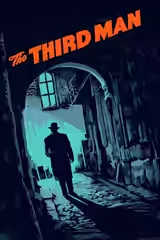
Most critics give The Third Man an emphatic recommendation, with praise clustering around Carol Reed’s direction and the atmosphere of postwar Vienna. The reviews repeatedly single out Robert Krasker’s shadow-heavy photography, the location shooting and Karas’s zither score as crucial to the film’s menace and sardonic humour. Graham Greene’s tightly plotted screenplay also draws praise for its moral complexity, while Orson Welles commands particular attention within a cast that earns broad approval.
The disagreement centres on whether that distinctive style strengthens the suspense or gets in its way. The New Yorker finds the camera angles excessive and the zither intrusive, judging the film less gripping despite its strong performances. Sight and Sound is more appreciative but finds some relationships thinly conveyed and the approach emotionally detached. The spread therefore runs from enthusiastic praise to a qualified minority response, rather than any substantial rejection of the film.
R
Radio Times
★★★★★ · David Parkinson
100
The review describes the film as a virtually flawless thriller and one of the best British films ever, praising its corker plot, memorable moments and perfect cast led by Welles and Cotten. It singles out Reed's mastery of place, angle and shade in creating a menacing Vienna, enhanced by Krasker's cinematography and Karas's zither music.
Read the full review →R
RogerEbert.com
8 December 1996 · ★★★★/4 · Roger Ebert
100
The critic praises the film's perfect match of zither score to its shadowy postwar Vienna intrigue and the director's choice to shoot on location amid real rubble rather than sets.
Read the full review →T
The Times
6 September 2019 · ★★★★★ · Ed Potton
100
Praises the impressive lineup of Greene, Welles, Reed and Korda behind this inky noir set in occupied Vienna, noting the bleak ending Reed chose and its timely sombreness seventy years on.
Read the full review →T
Time Out
7 August 2006 · ★★★★★ · Ben Walters
100
The review calls the film one of the most consummate British thrillers, highlighting Reed and Greene's sardonic vision of corruption realised through superb location work, a zither score and Welles' charismatic yet poisonous performance as Harry Lime. It notes the film's irony and serious-minded exploration of personal responsibility amid charming villainy.
Read the full review →E
Empire
1 January 2015 · William Thomas
90*
Carol Reed's cult 1940s thriller remains a masterclass in atmosphere and style that continues to unnerve and haunt audiences. It excels through its tense plot, character subtleties, brilliant photography, and the dominating presence of Orson Welles.
Read the full review →I
The Independent
10 August 2006
90*
This classic Graham Greene-scripted thriller improves with each viewing and reveals more humor. It follows a pulp writer investigating his friend's supposed death in post-war Vienna, uncovering black-market corruption amid iconic performances and striking visuals.
Read the full review →Out of modest aspirations arose a British movie masterpiece, drawing on film noir visuals in bombed-out Vienna with a pungent atmosphere of decay offset by the zither score. The perfectly judged performances, taut writing, and gripping set pieces make it one of the great British movies.
Read the full review →N
The New Yorker
4 February 1950 · John McCarten
50*
The review finds the film less gripping than Reed and Greene's prior collaboration, slowed by excessive trick camera angles and obtrusive zither music, though it notes strong performances from the cast.
Read the full review →F
Financial Times
3 September 2024 · Philip Kemp
Calls it the finest British movie of all time and an enigmatic masterpiece, highlighting the Reed-Greene partnership, postwar Vienna setting, and Welles’ finest screen performance as the charismatic Lime.
Read the full review →The review praises the film's atmospheric depiction of postwar Vienna through location shooting and zither score, along with sharply drawn characters and strong performances, especially by Welles, Cotten and Howard. It notes Reed's impressive stylistic control and skill as an analyst of mood, while observing that some relationships feel thinly conveyed and the overall approach is objective rather than personal.
Read the full review →A
The AV Club
9 July 2015 · A.A. Dowd
The critic calls The Third Man a masterpiece and one of the best films currently in theaters thanks to its 4K restoration, praising its collaborative artistry, atmospheric direction, Greene's script, Krasker's cinematography, Karas's score, and Welles's iconic performance as Harry Lime.
Read the full review →G
The Guardian
2 August 2015 · Philip French
The critic calls it a near-perfect noir classic from the Reed-Greene collaboration, praising the zither score, Krasker’s photography of postwar Vienna, and Welles dominating the film in presence and absence.
Read the full review →V
Variety
7 September 1949 · Clem.
The review calls it a full-blooded, absorbing story that reflects credit on all concerned, highlighting excellent camera work, direction, and performances especially from Orson Welles and Joseph Cotten.
Read the full review →E
Eye for Film
27 July 2015 · Laurence Boyce
90*
The critic calls The Third Man a triumph of direction, performance and script that remains a true classic more than 60 years after release. They single out Graham Greene’s tightly plotted, morally complex screenplay and Robert Krasker’s expressionist cinematography for particular praise.
Read the full review →Ordered by the weight we give each publication, then by score. Scores are normalised to 100; * means inferred from an unrated review. Summaries are ours, not quotations; follow the links for the reviews themselves. How we rate