A tidy half-hour in which Aaron Sorkin and his cast explain why the 1969 trial matters now. Everyone is articulate and nobody is challenged, and the archive footage from Chicago does more in thirty seconds than the interviews manage in twenty-eight minutes.
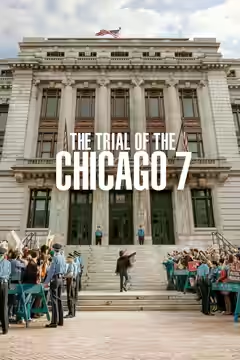
First, a word about what this is, because the title takes a while to say it. The Whole World is Watching is not Aaron Sorkin’s film about the 1969 conspiracy trial; that is The Trial of the Chicago 7 (2020), which runs over two hours and has Sacha Baron Cohen, Eddie Redmayne and a good many other famous faces in it. This is the 28-minute companion piece made to sit beside it, in which Sorkin and his actors talk about the trial, the film and the country. Most of the reviews so far that carry this title are in fact reviews of the feature, and they are warm, so their scores do not describe this. We would be warm about the feature too. This is a smaller thing and should be judged as one.
The form is the one you know. Sorkin, seated, explains the case: eight men charged with crossing state lines to incite a riot at the Democratic convention, a judge who behaved as if he were the prosecution, a defence that turned the courtroom into a stage. The actors take turns describing the men they play, and clips from the feature are cut against black-and-white newsreel of the real thing. It is well organised, it never dawdles, and it is exactly as long as it needs to be for the point it wants to make, which is that the arguments of 1968 are the arguments of now.
The newsreel is where we felt something. There is footage of Chicago police going into the crowd in Grant Park with clubs raised, and the crowd chanting the words of the title back at them, and for a few seconds the tasteful lighting and the reasonable voices drop away and we were watching people get hurt in 1968. Then it cuts to an actor telling us how powerful that footage is, and the feeling goes. It kept happening. The film has the real thing in its hands and keeps putting it down to talk about it.
What it does not have is anyone who disagrees. A making-of is a friendly form, and nobody expects the cast to complain about the script, but the trial itself was a fight between men who could not stand each other, Hoffman’s theatre against Hayden’s discipline, and Sorkin’s feature is at its best when it lets that fight breathe. Here everybody is on the same side, and the side is the film. Sorkin is fluent and likeable, and he says nothing about his own choices that a sharper interviewer could not have made him defend. Nobody asks whether the feature is too clean, which several critics of it did. Nobody asks why a film about a riot has such orderly crowds.
As a piece of filmmaking it is anonymous, which is the habit of the form rather than the fault of anyone in particular. The interviews are lit the way these interviews are always lit, the music is low and stirring and tells you when to be stirred, and the cutting between feature and archive is quick enough that for a beat you cannot always tell which is which. That last is the one interesting idea in it, and we are not sure it is intended. When Sorkin’s staged Grant Park and the real one slide past each other, the feature looks briefly like an expensive reconstruction and the reconstruction looks briefly like evidence. The film does not pursue this. It moves on to the next testimonial.
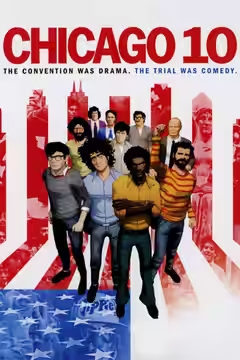
Against other companion pieces it is above average: it has a real historical argument and it makes it clearly, where most of these things have only a stunt coordinator and a lot of praise for the director. As a documentary about the Chicago trial it is not one, and Chicago 10 (2007) already exists. As half an hour of your evening it is fine, and fine is a low bar for a subject this loud.
Watch it after the feature, not before, and not instead. It will send you back to the newsreel, which is the best thing in it and which it did not shoot. If you have not seen Sorkin’s film, this is 28 minutes of people telling you it is good. They are right, and you would do better to spend the time finding out for yourself.