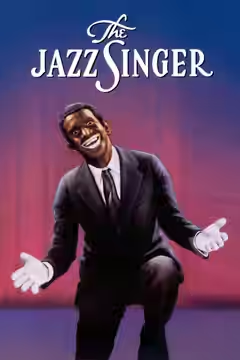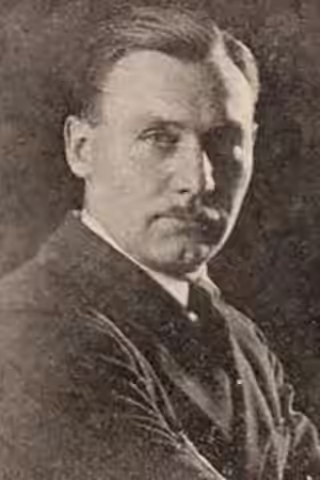
Alan Crosland worked at the forefront of early sound cinema, but we recommend The Jazz Singer chiefly for its singing. His handling of the family drama gives us less reason to celebrate.
Fi1m perspective
In The Jazz Singer (1927), Al Jolson's singing interrupts a much stiffer family melodrama. We perked up when he sang, because he makes those passages feel so much less laboured than the arguments surrounding them. The changes between silent-film storytelling and recorded voices are awkward, but they remain absorbing to watch. Crosland gives us reason to listen even when the drama has begun repeating itself.
Crosland came to sound after working in historical and costume pictures, including Under the Red Robe (1923). Elaborate sets and period detail were familiar territory before Don Juan (1926), which paired feature-length storytelling with a synchronised Vitaphone score and sound effects. His work with John Barrymore included the historical adventure The Beloved Rogue (1927) and, with Dolores Costello, the romantic drama When a Man Loves (1927). These films put The Jazz Singer in a useful context. Here was a director used to actors and spectacle, adapting his silent-film methods to recorded sound.
The limitation in The Jazz Singer is how little the family disagreement develops once it has been established. Alfred A. Cohn's screenplay keeps returning the characters to positions we have already understood, and Crosland does not make that repetition any more compelling. Jolson's singing supplies the immediacy that the dramatic scenes lack, but it cannot carry every stretch between songs. The blackface also demands scrutiny, and pleasure in the singing is no reason to put it aside.
Glorious Betsy (1928), a part-talkie historical drama, continued his association with Warner Bros.' sound experiments. His later career moved largely into B-pictures, including Massacre (1934). That later work deserves to be considered film by film, without assuming either that a sound pioneer must be a great director or that smaller assignments prove he had nothing left to offer. Begin with The Jazz Singer if early sound interests you; for family drama, look elsewhere.
Biography
Alan Crosland (10 August 1894 – 16 July 1936) was an American stage actor and film director. Born in New York City, he attended Dartmouth College and worked as a writer before entering the film industry. By 1917 he was directing feature-length films.
He directed several silent films for Warner Bros., including Don Juan (1926), the first feature-length film with a synchronised Vitaphone soundtrack. Crosland was chosen to direct The Jazz Singer (1927), the first feature film to include spoken dialogue, which helped usher in the sound era.
Crosland continued directing into the 1930s until his death at age 41 following a car accident in Los Angeles.