Aleksandre Koberidze makes three-hour films about ordinary Georgia on a phone camera that can barely see, and out of the smudges he gets something patient, odd and often lovely. We rate him, though his films ask more than they need to.
Fi1m perspective
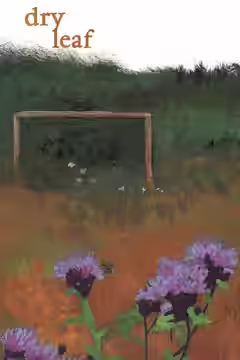
Somewhere in rural Georgia a cow stands on a football pitch, and on Aleksandre Koberidze's camera it is a brown rectangle on a green one. He shot the whole of Dry Leaf (2025) on a Sony Ericsson mobile phone nobody has owned for years, and it cannot hold a face at ten paces. That is the point. His films are made of things the picture almost misses: a pitch with no nets, a ball that is a dozen pixels, a village that seems to have more goalposts than people.
He made shorts from 2013 and has since made three features, roughly four years apart, each around three hours. Let the Summer Never Come Again (2017) set the pattern: a thin story laid over long stretches of watching Georgian streets and rooms as they are, in an image so low in resolution that audiences split over it. What Do We See When We Look at the Sky? (2021) put a love story with something magical in it into the city of Kutaisi, then spent much of its running time simply looking at Kutaisi. Dry Leaf sends a father round the villages after a daughter who has stopped calling, with a friend in the passenger seat whom nobody can see and the film never explains. Magic arrives in his Georgia the way weather does, and nobody remarks on it.
He has said of the phone, "With the Sony Ericsson, I could film people without taking something away from them," and on screen that comes out as a picture you have to help build. You work out what a moving blur is before the film tells you, and the country becomes something you have assembled from almost nothing. He edits everything himself, shot Dry Leaf with his own hands, and on one film handed the camera to Faraz Fesharaki. Giorgi Koberidze has scored all three features, and in Dry Leaf the music comes in rarely, under the driving, and lifts the road without instructing us. A football match late in the second hour, men in mismatched shirts and a referee nobody listens to, held for exactly as long as it lasted, moved us more than an image that rough had any right to, because by then we had spent two hours learning to read those smudges as people.
The cost is time. For the first twenty minutes of Dry Leaf we took the phone for a stunt, and a viewer who has not settled by then may never settle. The structures repeat, village after village, pitch after pitch, and what one person finds hypnotic another will find exhausting. The image divides people and always has; he knows this and has not changed it.
The cast and crew of Dry Leaf include members of his own family, and he is at work on something called Bilingual. Expect it to be long and to look like nothing else. Bring patience, and find the biggest screen you can for the smallest camera in the business.
Biography
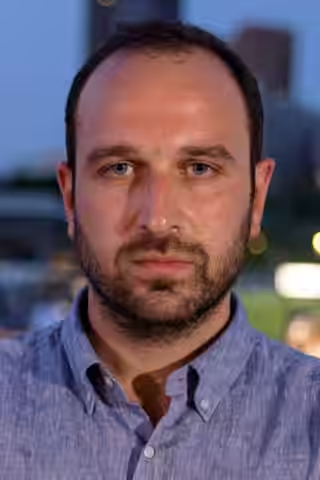
Aleksandre Koberidze is a Georgian filmmaker, screenwriter, editor and cinematographer. Born in Tbilisi in 1984, he studied film and television there from 2001 to 2005 before moving to Berlin in 2009 to study directing at the German Film and Television Academy Berlin (dffb).
His debut feature Let the Summer Never Come Again (2017), which he also wrote, edited, shot and produced, won the Grand Prix at the Marseille Festival of Documentary Film. His second feature What Do We See When We Look at the Sky? (2021) premiered in competition at the Berlin International Film Festival, where it received the FIPRESCI Prize. Dry Leaf (2025), his third feature, on which he again took multiple roles including director, writer, editor, cinematographer and producer, premiered in competition at the Locarno Film Festival.