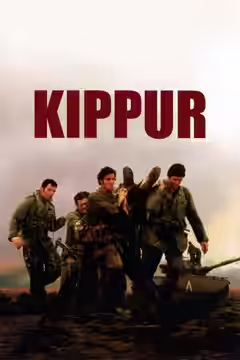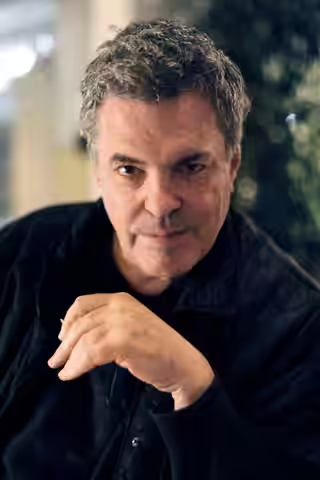
Amos Gitai’s films take their time over people and places. Kippur makes a strong case for that patience: we recommend its unsparing attention to a first-aid team, despite an opening that delays the real work.
Fi1m perspective
In Kippur (2000), a first-aid team works to help the wounded while remaining exposed to the fighting. Gitai, who directs, co-writes and produces, keeps our attention on how much effort helping another person requires. He finds enough drama there without making every useful act an occasion for heroism. We found the battlefront scenes punishing because the team’s ability to help gives them so little protection. It is a forceful film that earns its discomfort.
His attention to places was there in House (1980), his first feature-length documentary, which follows a single house in West Jerusalem through differing accounts of its history. The shift towards fiction features came in the 1990s, but houses, cities and borders remained recurring subjects. Gitai often returns to such subjects across trilogies or continuing series, making room for more than one person’s account. His long takes connect spaces and give us time to notice the surroundings as well as the people passing through them.
Cinematographer Renato Berta has worked with Gitai repeatedly, including on Kippur. The extended opening take of Free Zone (2005) and the single 81-minute shot of Ana Arabia (2013) show how far Gitai is prepared to pursue an uninterrupted scene. That approach gives us time to attend to people and their surroundings, but also makes any lack of dramatic purpose harder to ignore.
The opening of Kippur, with Weinrub and his girlfriend, exposes the limit. It ought to establish someone whose private life matters once the fighting begins, but the introduction feels detached from the work that makes the film persuasive. Gitai and co-writer Marie-José Sanselme, a recurring collaborator from 2000 onwards, write more convincingly once the team’s task gives their scenes a direct purpose. Start with Kippur, but choose an evening when watching people struggle to help the wounded will not be too much.
Biography
Amos Gitai is an Israeli film director, writer and producer. Born in Haifa in 1950, he studied architecture at the Technion in Haifa and later earned a PhD in the subject at the University of California, Berkeley.
Gitai served in a helicopter rescue unit during the 1973 Yom Kippur War and was injured when his helicopter was shot down. The experience prompted him to turn to filmmaking. He directed his first feature-length documentary, House, in 1980 and went on to make dozens of documentaries and feature films, often addressing Israeli history and society.
His work includes the autobiographical war film Kippur (2000), on which he also served as writer and producer, as well as Free Zone (2005) and Disengagement (2007). He has lived and worked for periods in France and maintains an active international career.