Amvrosii Buchma makes a soldier’s laughter frightening without needing words. We value his physical precision and restraint, though the formal grandeur of the Ivan the Terrible films sometimes keeps his work at a distance.
Fi1m perspective
In Arsenal (1929), Buchma’s gas-poisoned German soldier laughs convulsively. We were horrified by that laughter, because his contorted face makes it impossible to mistake for amusement. The appearance is brief, and its effect depends on his control of facial expression. It gives us a direct introduction to an actor whose gestures could remain precise even when the feeling was violent.
His work with Les Kurbas at the Berezil theatre overlapped with a concentrated period in silent cinema between 1926 and 1930. The leading role of Hordii Yaroshchuk in The Night Coachman (1928) shows that his silent career was not confined to brief appearances. His sound-era character studies added rich vocal intonation to that close attention to physical detail.
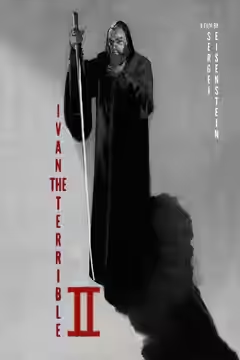
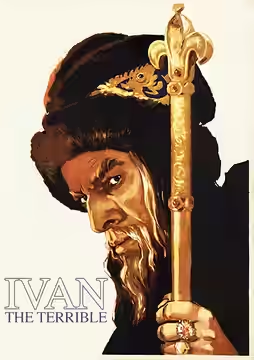
In Ivan the Terrible, Part I (1944), he plays the Czar’s guard Aleksei Basmanov for Sergei Eisenstein. His use of eyes and small gestures fits the film’s formal acting style, though that fit has its drawbacks. Nikolay Cherkasov’s severe central performance and the forceful images make this the stronger of the two parts, and one we recommend. But the people can feel remote, however closely we watch them. Buchma gives us precise physical details to attend to; he cannot, by himself, make Eisenstein’s court feel less forbidding.
In Ivan the Terrible, Part II: The Boyars' Plot (1958), Buchma returns as Basmanov, but the stiff performances and heavy pacing make the drama harder to care about. The colour banquet and Sergei Prokofiev’s score reward patience without making the characters much closer. This is a qualified recommendation for viewers interested in filmmaking, rather than an absorbing story. We would not use its shortcomings to dismiss Buchma, but nor would we claim his supporting work repairs them. Start with the first part; turn to Arsenal for a briefer and more disturbing encounter with the actor.
Biography
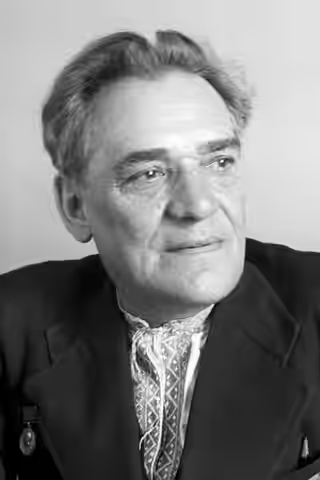
Amvrosii Buchma was a Ukrainian and Soviet stage and film actor, director and pedagogue. Born in 1891 in Lviv, then part of Austria-Hungary, he trained at the Lysenko Institute and began working as an extra at the Russkaia Beseda theatre in Lviv from 1905. After military service in the First World War he returned to the stage, appearing in leading roles in Kharkiv before joining the Ivan Franko Theatre in Kyiv in 1936, where he also directed.
Buchma made his film debut in the mid-1920s and became known for roles including the German soldier in Aleksandr Dovzhenko’s Arsenal (1929) and Czar’s Guard Aleksei Basmanov in Sergei Eisenstein’s Ivan the Terrible, Part I (1944) and Ivan the Terrible, Part II: The Boyars’ Plot (1958). He was named People’s Artist of the USSR in 1944 and received two Stalin Prizes. He died in Kyiv in 1957.