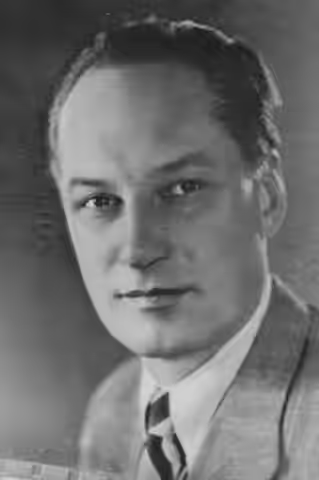
Andrei Abrikosov brings a sturdy, convincing authority to warriors and boyars. We value his physical presence in Eisenstein’s films, with the reservation that their formal acting can leave us admiring the figures without feeling close to the people.
Fi1m perspective
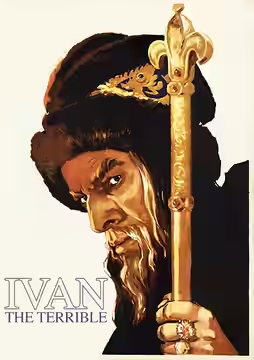
Andrei Abrikosov looks at home among men who expect to be obeyed. As Boyar Fyodor Kolychev in Ivan the Terrible, Part I (1944), he has the physical assurance Sergei Eisenstein’s severe court requires. That makes him persuasive casting, even when the formal style gives us little access to private feeling. We were stirred by Eisenstein’s forceful images and Nikolay Cherkasov’s severe performance, though we wanted to feel closer to the people.
His film career began with Grigory Melekhov, the lead in the silent And Quiet Flows the Don (1930). By Alexander Nevsky (1938), in which Eisenstein cast him as Gavrilo Oleksich, his imposing appearance was being put to use in a historical warrior role. The title role in Stepan Razin (1939) extended that pattern. These parts require an audience to accept a man’s authority quickly, and Abrikosov’s physical presence gives a director a firm starting point.
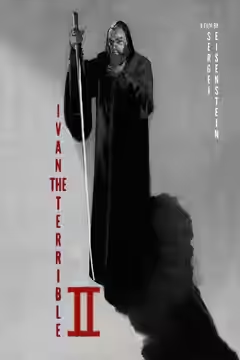
The formality is less rewarding in Ivan the Terrible, Part II: The Boyars' Plot (1958), where he plays Archbishop Philip, formerly Kolychev. Carrying the same figure across both films gives his contribution continuity, but the second film is harder going. Its stiff performances and heavy pacing leave too little room for absorption in the story. The colour banquet and Sergei Prokofiev’s score reward patience; they do not make the acting more involving. We would recommend it to someone interested in Eisenstein’s methods before someone looking for an introduction to Abrikosov.
Outside Eisenstein, later work included Prince Vladimir in Ilya Muromets (1956) and Balyasny in the comedy Wedding in Malinovka (1967). His work with the Vakhtangov Theatre also included Othello and Jean Valjean, so the screen’s succession of commanding historical figures was only part of his acting life. Those other roles are worth remembering before treating the stiffness of an Eisenstein film as the sum of his abilities. Start with Ivan the Terrible, Part I, allowing for a style that keeps its people at a distance.
Biography
Andrei Lvovich Abrikosov (14 November 1906 – 21 October 1973) was a Soviet stage and film actor. He appeared in films from the early 1930s until the early 1970s.
Abrikosov is known for his roles as Gavrilo Oleksich in Alexander Nevsky (1938), Boyar Fyodor Kolychev in Ivan the Terrible, Part I (1944) and Archbishop Philip in Ivan the Terrible, Part II: The Boyars' Plot (1958), Prince Vladimir in Ilya Muromets (1956) and Wedding in Malinovka (1967). He received the Stalin Prize in 1941 and was named People's Artist of the USSR in 1968.
His son, Grigori Abrikosov, was also a film actor.