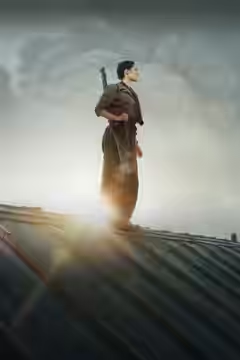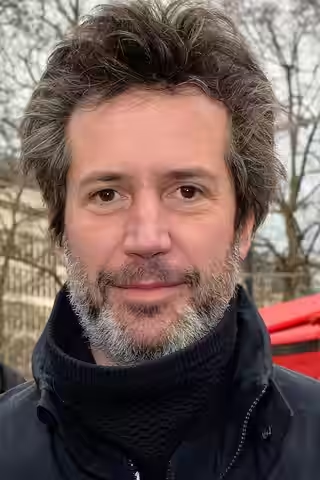
Antonin Baudry came to film from the foreign ministry and makes large, hurrying pictures about France at war, each with a stubborn man at the centre. He is good on rooms and arguments, less good at the doubt he says he is after.
Fi1m perspective
In De Gaulle: Liberté (2026) the Free French headquarters in London is dressed by Benoît Barouh with the clutter of an organisation run on borrowed furniture, and it looks poorer than every other office in the film. That is Antonin Baudry's idea of the man in one room. No territory, no money, an ally who cannot stand him, and a refusal to consider any outcome but winning. Baudry likes people with nothing but their nerve, and he likes to put them inside a very large machine.
He knows the machine from the inside. Before he made films he was a diplomat and a speechwriter, and the first thing that got him noticed was the comic Quai d'Orsay (2010–2011), drawn by Christophe Blain and written by Baudry under the name Abel Lanzac from his own years in the ministry. It was filmed in 2013, with Baudry on the screenplay. He resigned around 2015 to write and direct, and The Wolf's Call (2019) was his first feature: a submarine thriller built on the technical detail of how such boats work, and the first sign of the pattern. A military story told at scale, with one person's judgement holding it together. Then the two-part de Gaulle, Résistance and Liberté, both 2026, written with the historian Bérénice Vila.
What works is the movement. Liberté hops from London to the North African desert to occupied France like a serial, Rehman Nizar Ali keeps every strand short, and Pierre Cottereau lights the desert hard white and the offices the brown of old varnish, so you always know where you are before anyone speaks. The diplomatic years show most in the scenes of men at tables. Simon Abkarian's de Gaulle and Simon Russell Beale's exasperated ally bickering their way towards Paris is the best of the film, because Baudry understands that sovereignty is argued for in rooms long before it is won in the field. He writes his minor players with care, and Karim Leklou's Blazej with a sharper tongue than anyone else in the picture.
What does not work is the worship. Baudry says the point was "to demystify de Gaulle, to rediscover the human being behind the legend", and we believe he meant it. But Liberté shares its hero's certainty completely, and a film that cannot imagine its subject failing has a hard time showing him as a man. We were happy to be carried along for two hours; then, with twenty minutes still to run of 159, the anthem was still playing at full volume and we found we had stopped forgiving it.
He has now made two large films about France at war and one comic about its foreign ministry at peace, and the films are the ones that lack the doubt. We would like to see him let it in, since he plainly knows how power behaves when nobody is watching. Until then he is a reliable maker of handsome, hurrying pictures about stubborn men, and that is a sturdier thing to be than most first-time biographers of a general manage.