Béla Tarr’s long takes and stark landscapes reward sustained attention, though not every extra minute earns its place. We recommend his cinema for its absorbing images and concentration on people, without treating patience as a qualification for enjoying it.
Fi1m perspective
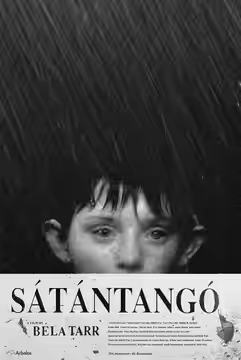
Tarr’s camera moves slowly across rain-soaked, muddy landscapes, and a shot can last several minutes. He gives us time to look, then keeps us there after we think we have seen enough. That can be absorbing or simply tiring, sometimes within the same passage. We rate Satantango (1994) highly because its images and performances sustain so much of that attention, though we would not defend every minute.
His early social realism used non-professional actors, beginning with Family Nest (1979). Almanac of Fall (1984) marked a move towards longer takes and a more atmospheric style. With Damnation (1988), his first collaboration with novelist László Krasznahorkai, the familiar black-and-white approach took hold. It continued through Werckmeister Harmonies (2000) to The Turin Horse (2011), his final feature.
In the 432-minute Satantango, Tarr and Krasznahorkai adapt the latter’s novel with considerable confidence in our willingness to stay. The writing gradually gives us enough interest in the people to make the undertaking worthwhile, rather than relying on the weather alone. We were absorbed by its concentrated performances and monochrome images, once we had adjusted to its pace. There are stretches, though, where we understand what a passage is doing well before the film is ready to leave it.
Gábor Medvigy was a core cinematographer from Damnation onwards, and the stark black-and-white landscapes are central to the films’ oppressive atmosphere. Ágnes Hranitzky worked as editor and later co-director, a useful reminder that these carefully timed films were made in collaboration. Composer Mihály Víg’s repetitive scores make it harder to shake off that atmosphere. The music keeps returning, just as the films return to actions that a brisker storyteller would show us once.
We recommend setting aside a substantial part of a day for Satantango, rather than approaching it as a test of endurance. After the adjustment, it is possible to stop measuring the length and take pleasure in looking. There is no need to pretend that every passage holds us equally, or to mistake an occasional lapse of concentration for defeat. Choose a day when nobody needs to be anywhere else.
Biography
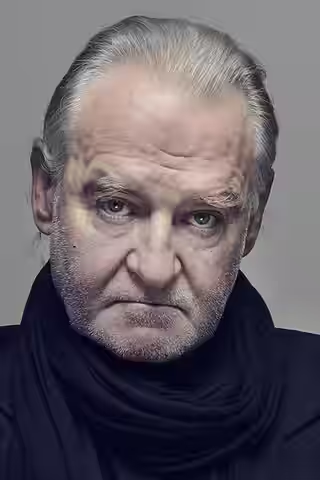
Béla Tarr is a Hungarian film director and screenwriter. He was born on 21 July 1955 in Pécs and grew up in Budapest. His debut feature, Family Nest (1979), was followed by several early works in a realist style.
From Damnation (1988) onwards, Tarr collaborated frequently with editor Ágnes Hranitzky, novelist László Krasznahorkai, composer Mihály Víg and others. His later films are distinguished by extended long takes in black and white. Key works include Sátántangó (1994), Werckmeister Harmonies (2000), The Man from London (2007) and The Turin Horse (2011). He announced his retirement from directing after the latter film and later taught at the film.factory school in Sarajevo.
Tarr died on 6 January 2026 in Budapest after a long illness, aged 70.