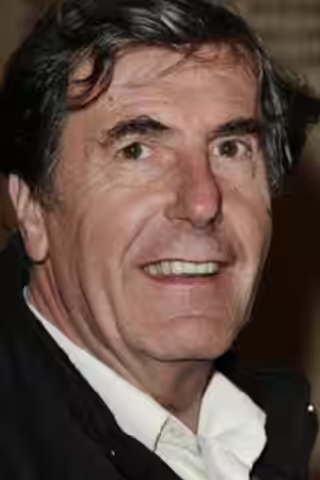
Bernard Ménez has spent half a century playing the man at the table who is slightly too pleased with himself, for Rozier and Truffaut as readily as in the broadest comedy, and he is at his best when a director lets the joke hurt.
Fi1m perspective
In Tonnerre (2014) Bernard Ménez cheats at cards. He does it badly, on purpose, so that his son will catch him, and the pleasure on his face when he is caught is the whole character: a quick, needling man who would rather be found out than be ignored. Vincent Macaigne, large and apologetic across the table, is the film's subject. Ménez is the noise around him, and he has been making some version of that noise since 1973.
He came to acting sideways, from teaching maths, physics and chemistry, and started in 1969. Jacques Rozier gave him his film debut in Du côté d'Orouët (1973), the same year Truffaut put him in La Nuit américaine, and the part he fixed then, the awkward, clumsy man you end up fond of, is the part he has been offered ever since. Pascal Thomas offered it most often, ten films beginning with Le Chaud Lapin (1974). Rozier came back to him for Maine-Océan (1986), as a ticket inspector, and that is the film people who care about him name first. In between he took what was going: three films for Jean-Pierre Mocky, La Flèche opposite Louis de Funès in L'Avare (1980), a part he asked for himself in de Funès's dressing room, and a run of cheap comedies that French critics file under nanars. He has never seemed to draw a line between the two kinds of work.
The usual complaint is that it is always the same man, and the complaint is fair. Thomas used him as a type and the type did not grow. What changes is what the director does around him. In Tonnerre Guillaume Brac lets the kitchen jokes run for an hour and then shows us what they were covering. We were laughing at Ménez across that table, quite happily, and then a scene of Macaigne sitting alone in his car in the dark made us properly uncomfortable, because we saw that neither man had said the one thing that mattered and the needling had been how the father avoided it. The performance had not changed. Our view of it had. Ménez plays the surface, and it is up to the director to show what is under it.
Start with Tonnerre, which uses him exactly as he should be used, as the loud man in a quiet film. Then look for the Rozier films, where he is younger and looser and the joke has not yet turned. He has kept working, on stage and as a singer as well as on screen, and the type has outlasted most of the directors who fixed it. He will presumably go on being cast as the man who is slightly too pleased with himself, and on the evidence of Tonnerre that is still a good use of an evening.
Biography
Bernard Ménez is a French actor and singer. Born on 8 August 1944 in Mailly-le-Château, Yonne, he began his screen career in 1969 with Jacques Rozier’s Du côté d’Orouët and went on to appear in more than seventy films.
He is particularly associated with the work of Rozier and Pascal Thomas, appearing in films including La Nuit américaine (1973), Le Chaud Lapin (1974) and Maine-Océan (1986). Other notable roles include appearances in La Grande Bouffe (1973), L’Avare (1980) and L’Amour dure trois ans (2011). In Tonnerre (2013) he played the father of the central character, for which he received the jury prize for best supporting actor at the 2014 Festival Jean-Carmet de Moulins.