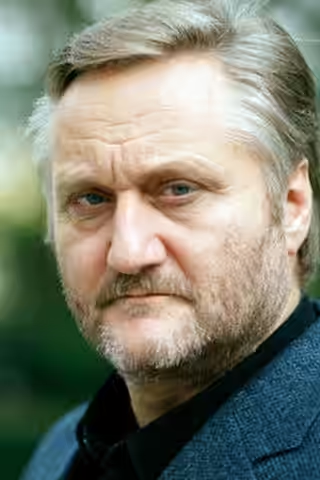
Donnadieu's trick was to look like nobody. A large man with a hard face who kept still and spoke quietly, he made ordinary Frenchmen frightening, and in The Vanishing he gave the cinema one of its most reasonable monsters.
Fi1m perspective
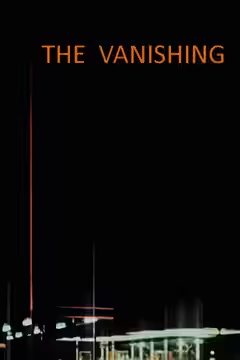
Raymond Lemorne sits in his car and rehearses. He is a husband with a wife, two daughters and a cardigan, and he is teaching himself to take a stranger off the street, badly at first and then less badly. Bernard-Pierre Donnadieu plays him in The Vanishing (1988) with almost nothing: no twitch, no glint, no sign that he knows anyone is watching. We have sat through a great many screen murderers and this one frightened us more than most, because a man who practises has a method, and Donnadieu never once lets us see him enjoy it. He is simply getting better at something.
The face did the casting. It was hard, the gaze direct, the frame large, and French cinema decided early what to do with it. After small parts from 1976, among them The Tenant, he was noticed as Inspector Farges opposite Jean-Paul Belmondo in The Professional (1981), and the decade gave him the title role in The Return of Martin Guerre (1982) with Gérard Depardieu, a gang leader in Rue Barbare (1984) and a brutal, damaged knight in Bertrand Tavernier's La Passion Béatrice (1987). Villains, criminals, men in authority who might do something terrible in the next shot. He was good at them, and the cinema rarely asked him for anything else. He had a reputation for being difficult on set and for preferring a few good parts to a great many, which cannot have helped.
What he did inside those parts was keep still. "Plus on s'efface, plus on est discret, plus on est présent," he said in 2005: the less you do, the more you are there. It sounds like something an actor says, until you watch Raymond deliver his long account of himself on a long drive in The Vanishing and realise that Donnadieu has made every sentence of it sound reasonable without raising his voice once. We did not want him to stop, and we were not proud of that. Sophie Dussaud's cardigans and open collars do the rest; this is what such a man looks like, the film says, and nobody looked twice.
Television let him use the same stillness for other ends. Yves Boisset cast him eight times, often as historical figures, and there the closed face reads as a man holding something down rather than something in. He worked on stage with Georges Wilson, did a great deal of voice work, and returned to cinema in Paris 36 (2008). He noted, drily, that every director tells his actors he has cast them in a part nobody has seen them in before. Start with The Vanishing, and do it the way Sluizer wanted: knowing nothing about the last twenty minutes. Then decide whether the directors were right.
Biography
Bernard-Pierre Donnadieu was a French actor. He appeared in more than 100 films and television productions between 1974 and 2010, as well as in theatre, and was frequently cast as a villain, criminal or psychopath. He was also the French voice of many lead roles in English-language films.
He studied theatre and literature at the Sorbonne Paris III. Early notable roles included appearances in The Tenant (1976) and The Professional (1981). He played the title character in The Return of Martin Guerre (1982) and Raymond Lemorne in The Vanishing (1988), for which he received best acting awards at the Madrid Film Festival in 1989 and the Porto Film Festival in 1990. He was nominated for a César Award for best supporting actor for his role in Rue Barbare (1984). His final film appearance was in Paris 36 (2008).
Donnadieu had a daughter, the actress Ingrid Donnadieu.