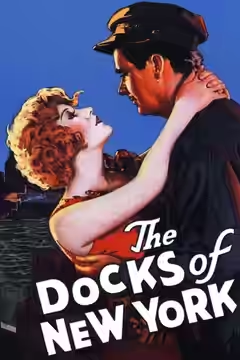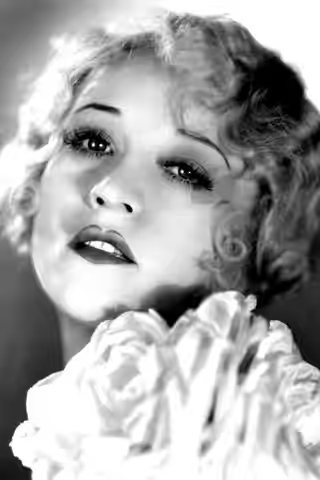
Betty Compson lets a troubled woman keep her pride, and makes us care without insisting on pity. We rate her highly in The Docks of New York, even when its melodrama gives her less to work with.
Fi1m perspective
In the Sandbar tavern in The Docks of New York (1928), Betty Compson's Mae gives us more to watch than the romance alone requires. George Bancroft supplies Bill Roberts with the necessary presence, but Compson and Olga Baclanova, as Lou, suggest pride and hurt that make the simpler emotions around them seem thin. We were moved by those communal scenes because the women helped make the crowd feel like people with troubles beyond this one evening. Josef von Sternberg's smoke-filled images deserve attention, but we kept looking for the faces within them.
Compson began in Al Christie comedy shorts in 1915, then broke through in features opposite Lon Chaney in The Miracle Man (1919). Paramount stardom followed between 1921 and 1925, before a late-1920s resurgence with The Docks of New York and The Barker (1928). In the latter she plays Carrie, a manipulative carnival girl, a useful reminder that her troubled women were not always there simply to be pitied. Mae offers the more compelling evidence for us: Compson makes her sympathetic without asking us to forget her pride.
She made the transition to sound successfully, with a voice that recorded well. In James Cruze's The Great Gabbo (1929), she plays Mary, the put-upon assistant to a ventriloquist, opposite Erich von Stroheim. It is another part in which an actress has to make someone worth watching while someone else treats her badly. Character roles followed through the 1930s and 1940s, including Gertie in Alfred Hitchcock's Mr. & Mrs. Smith (1941). Those smaller jobs need not become neglected triumphs for us to take her earlier work seriously.
The caveat is clearest in the film we most readily recommend. Some of The Docks of New York is blunt melodrama, and Compson cannot make that disappear. Her work with Baclanova does, however, keep us interested when the film settles for less complicated feelings than the performances suggest. Start with von Sternberg's film; its blunt passages are worth accepting for the time spent with Mae and Lou.
Biography
Betty Compson, born Eleanor Luicime Compson, was an American actress and film producer. She began her career in 1915, appearing in numerous silent shorts and features, and later worked as a producer.
She is best known for her performances as Mae in The Docks of New York (1928) and as Carrie in The Barker (1928); the latter role earned her a nomination for the Academy Award for Best Actress. Compson continued acting into the sound era and received a star on the Hollywood Walk of Fame for her contributions to motion pictures.