Bill Morrison makes films from reels that time has already half-destroyed, and lets the rot do the talking. When the pictures are strong enough, as in Dawson City: Frozen Time, the method is remarkable; his taste in scores is less reliable.
Fi1m perspective
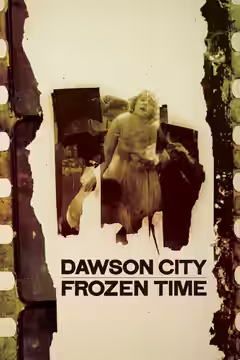
A line of dancers kicks in step while the wall behind them blisters white. That is the Bill Morrison image, and it is in Dawson City: Frozen Time (2017). He did not make it; fifty winters in a disused Yukon swimming pool made it, and his job was to dig it out and leave it alone. Most of what he has done for thirty years comes down to that decision. What water and chemistry have done to a strip of nitrate is treated as part of the picture, not as damage to be worked around.
He began with found footage in the early 1990s, and Decasia (2002) is where the habit became a reputation: a feature built from deteriorating prints, cut to a score by Michael Gordon. From there the films widened. The Miners' Hymns (2011), with Jóhann Jóhannsson, takes archive footage of English mining communities; The Great Flood (2013), with Bill Frisell, builds a history of the 1927 Mississippi flood; Beyond Zero: 1914–1918 (2014) puts the First World War through footage whose physical damage matches what is being shown. Narration is sparse or absent, and he does much of the research and the editing himself. He has said that his films "are not a conversation with the past as much as how that past has aged to become part of the present".
What works is the trust in the pictures. Dawson City tells the history of a gold-rush town and of cinema's first decades in captions and salvaged reels, almost without speech, and it is the best case for the method we have seen. We thought we knew what was coming, and we were still caught out: we sat there more moved than we could account for, watching those dancers finish while the frame melted round them. The one time the film hands over to a talking head, a passage on the 1919 World Series, it becomes a different and lesser film.
What does not always work is the music. Morrison cuts to scores that already exist, developing image and music together or music first, and when the composer is right the result is a single object. In Dawson City the score, by Alex Somers, is the trouble; it tells us how to feel about pictures that had already done the work, and it is one reason two hours feel like too many. There is a fair charge that a career spent on decay risks being only about decay, and that the associative cutting is hard to follow without knowing the sources. The films of the 2010s answer it with more about labour and disaster and less about chemistry.
He is still at it, with Incident (2023) among the recent work. Start with Dawson City, and go in knowing that the reels are the reason and everything laid over them is scaffolding.
Biography
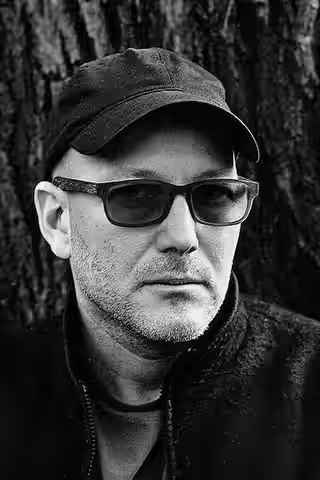
Bill Morrison is an American filmmaker and artist based in New York. Born in Chicago in 1965, he attended Reed College and graduated with a BFA from the Cooper Union School of Art in 1989. His films frequently combine rare archival footage with contemporary music and have been screened in theatres, museums and concert halls worldwide.
Morrison is best known for Dawson City: Frozen Time (2016), which he directed, wrote, edited and produced. The documentary explores the history of the Yukon town of Dawson City through nitrate films discovered there in 1978. It premiered at the Venice Film Festival and received awards including a Critics' Choice Award for Most Innovative Documentary. Other notable works include Decasia (2002), the first 21st-century film added to the Library of Congress National Film Registry.