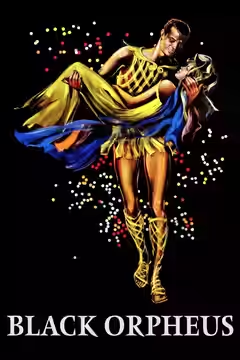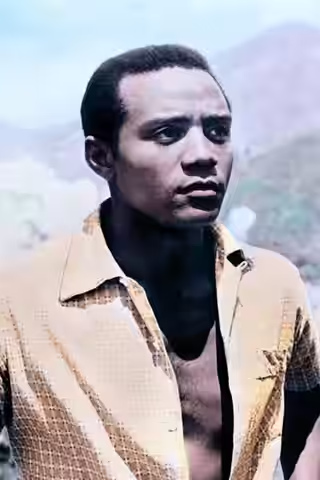
Breno Mello’s physical ease makes him an appealing lead in Black Orpheus. We like him in the part, though his limited dramatic expression and an underwritten romance keep the lovers from becoming people we care deeply about.
Fi1m perspective
In Black Orpheus (1959), Breno Mello makes sense as soon as Orfeo is in motion. There is an ease to his presence amid Rio’s Carnival that helps Marcel Camus’s film keep its pleasures immediate: dancing, colour and music need no explanation. Mello plays a trolley-car driver and guitarist, and he is likeable company without making the character especially complicated. The difficulty comes when the film asks us to care deeply about his love for Eurydice.
Mello came to the role from professional football, with no previous acting experience, and Camus uses his movement and natural presence more successfully than his dramatic expression. That is a real contribution to the film, but it is worth being precise about what belongs to whom. The singing voice is Agostinho dos Santos’s, while the music is by Jobim and Bonfá; the pleasure of those songs cannot simply be credited to the man we see. Mello makes the man performing them seem relaxed and approachable.
Marpessa Dawn, as Eurydice, supplies a directness that helps the romance when Jacques Viot’s screenplay has done little to prepare it. Mello is less expressive, but the problem is not his alone: the couple are too dependent on our recognising the myth behind their names. We were frustrated by their love story because the film gives them so few small, particular reasons to need each other. His charm cannot make up for what the screenplay leaves out. We can enjoy the Carnival scenes and still wish Camus had spent more time establishing what draws these two people together.
His later credits include Os Vencidos (1963), O Negrinho do Pastoreio (1973) and Prisoner of Rio (1988), where he plays the non-speaking Silencio. They did not add up to a sustained acting career; Black Orpheus remains his defining role. Watch it for the dancing and music, and for Mello’s ease within them, rather than expecting the love story to carry the evening.
Biography
Breno Higino de Mello was a Brazilian actor and footballer. He played the title role of Orfeu in the 1959 film Black Orpheus (Orfeu Negro), directed by Marcel Camus.
Before his acting career, Mello played professional football for clubs including Grêmio Esportivo Renner, Santos FC and Fluminense. He later appeared in a small number of other films, including Os Vencidos (1963) and Prisoner of Rio (1988), and featured in the 2004 documentary In Search of Black Orpheus.