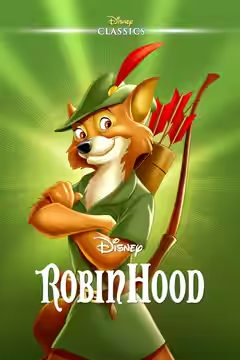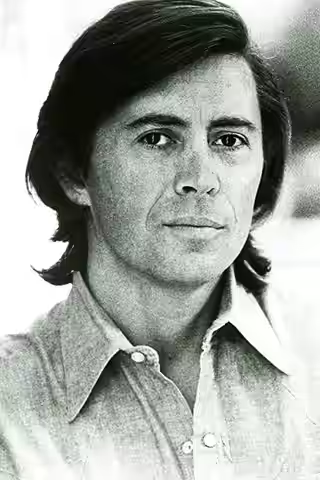
For most of the world Brian Bedford is the voice of a fox. The voice is the clue: clear, measured, every consonant in place, the sound of a classical actor who spent his real career elsewhere and lent the screen a little of it.
Fi1m perspective
Listen to the fox. In Robin Hood (1973) Disney's outlaw is drawn light and written lighter, a charmer given nothing to charm with except a run of disguises, and we said as much when we reviewed it. But close your eyes for a minute. Every word lands where it should, the vowels are clean, the pace is easy, and when Robin puts on a disguise the voice shifts register without losing its shape. That is Brian Bedford, and it is very nearly all the screen ever got of him.
The rest happened in front of live audiences. From 1975 he was a fixture of the Stratford Festival in Ontario, where he appeared in more than 50 productions and directed over 20, and he kept returning to Broadway between seasons. His speciality was Molière, and Arnolphe in The School for Wives (1971) is the part people still name first; he played jealous, self-deceiving men and took them seriously. He was also a Coward and Wilde man, Elyot opposite Maggie Smith in Private Lives (1978), and at the end Lady Bracknell in The Importance of Being Earnest (2009), which he directed as well. Film was an occasional thing: Scott Stoddard in Grand Prix (1966), Clyde Tolson in Oliver Stone's Nixon (1995), and the fox.
His own account of what he did is blunt: "I specialize in playing utterly foolish men, who are utterly humorless and utterly deluded." That is comedy of a particular kind, built on precision and on a fool who does not know he is one, and it is where his reputation rests. The tragedies drew cooler notices; his Macbeth (1990) and his Lear (2007) at Stratford were generally counted as disappointments. The pattern makes sense of the fox. Bedford's instrument was made for a man who wants something badly and is wrong about it, and Disney's Robin wants nothing beyond the next trick. Peter Ustinov and Terry-Thomas got the film's appetite. Bedford got the diction.
We came away from Robin Hood liking the hero less than the villains and feeling slightly guilty about it, because the voice plainly deserved a better fox. Nothing in Clemmons and Anderson's string of sketches gives Robin a flaw to play or a want to follow, so the one thing Bedford could have done, make a fool of a hero, is never asked of him. What survives is the sound, and the sound is good enough that small children still recognise it.
Anyone curious about the actor should start with the fox, since it is the only place most of us can, but they should listen rather than look. The picture shows a cheerful cartoon; the soundtrack carries a classical career that happened somewhere else.
Biography
Brian Bedford (1935–2016) was an English actor known for his work in theatre, film and television. He trained at the Royal Academy of Dramatic Art in London and appeared in numerous stage productions, particularly of Shakespeare and other classical playwrights. He was nominated for seven Tony Awards and won one, for his performance in a 1971 Broadway revival of Molière’s The School for Wives.
On screen, Bedford played supporting roles in films including Grand Prix (1966) and Nixon (1995). He provided the voice of the title character in the Disney animated feature Robin Hood (1973). His television credits include appearances in Cheers (1988), Frasier (2000) and Murder, She Wrote.