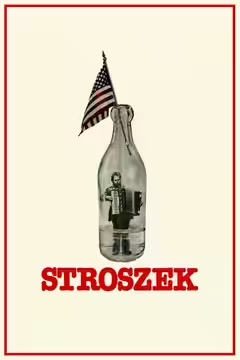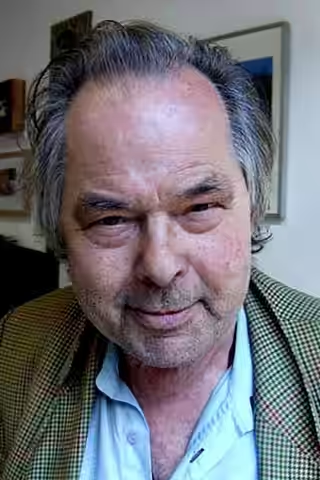
Bruno Schleinstein had no training, made two films that matter, and in both of them he simply stood in front of Werner Herzog's camera and let it look at him. It worked, it is hard to watch, and Stroszek (1977) is the one to see.
Fi1m perspective
Watch him deliver a line in Stroszek (1977). He looks slightly past the person he is talking to, gets partway through a sentence, stops, and notices something nobody else has seen. He calls himself Bruno, in the third person. None of this is technique. Bruno Schleinstein had no acting training, and Werner Herzog, who made the only two films in which he matters, never asked him to acquire any.
Herzog found him in a 1970 documentary, Bruno der Schwarze – Es blies ein Jäger wohl in sein Horn, in which he appeared as himself, a self-taught street musician and painter who drove a forklift in a steel mill. Four years later he was the isolated foundling in The Enigma of Kaspar Hauser (1974), and the part fitted him closely enough that critics have never quite separated the man from the role. Then Herzog wrote Stroszek for him, put his Berlin flat and his own music into it, and sent him to Wisconsin. After that there is very little: a part in Liebe das Leben, lebe das Lieben the same year, some appearances for Miron Zownir in the 2000s, and the music and painting he kept up until he died in Berlin in 2010. Two films, three years apart. That is the whole of it.
What he gives Herzog is presence with nothing held back, and Herzog knows how to frame it. Stroszek is built so that the people around Bruno are as odd as he is: Eva Mattes, tired and patient as Eva; Clemens Scheitz, small and courteous, with his homemade instrument for measuring things nobody believes in. Nobody is asked to act normal next to him, so he never looks like the exhibit. There is a speech in the mobile home about how in Germany they kicked him in the open and in America they do it with a smile, and Schleinstein says it looking slightly past Eva, working it out as he goes. It moved us more than we expected, because the words are not good and he means every one of them.
The obvious question is whether we are watching a performance or a man, and whether Herzog should have been filming him at all. Schleinstein was hard to work with; Herzog has said scenes waited while he spoke or shouted about injustices done to him before he could begin. Schleinstein had his own answer to that charge: "I have my pride, and I can think, and my thinking is clever." What is on screen is not a specimen. It is a man who knew he was being looked at and decided what to show.
Start with Stroszek. Kaspar Hauser is the more famous part, but Stroszek is the one in which Herzog plainly likes him, and it is the one that makes you wonder why nobody else thought to write him a film. Nobody did.
Biography
Bruno Schleinstein, credited as Bruno S., was a German actor, musician and artist. He was discovered by Werner Herzog after appearing in the 1970 documentary Bruno der Schwarze – Es blies ein Jäger wohl in sein Horn and made his screen debut with no prior acting experience.
Herzog cast him as the lead in The Enigma of Kaspar Hauser (1974). He subsequently starred in Stroszek (1977), a film written expressly for him that drew on aspects of his own life; scenes were shot in his Berlin apartment and he performed his own music in the role of Bruno Stroszek.
Schleinstein was born in Berlin on 2 June 1932 and died there on 11 August 2010.