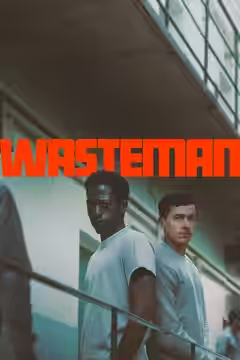
Cal McMau has made one feature, and it is enough to know what he is after: prison seen twice over, once by the camera and once by the phone in somebody's pocket. The method is sharp. The film around it is the usual one.
Fi1m perspective
A man goes down on the floor of a wing in Wasteman (2026), and we see it first from where he lies, and then again, from the phone that was pointed at him. That second view, handheld and badly lit and cut straight into the film, is what Cal McMau has brought to the British prison picture. He has said the film draws on the footage prisoners smuggle out themselves, and it shows: the beatings look like the clips, not like a film pretending to be one.
McMau began as an artist, moved into animation and motion graphics for television, and then spent fifteen years directing music videos and commercials while making short films. That is a long apprenticeship in doing a lot inside a small frame, and it is the part of his training that shows. He likes a confined space and he builds the tension in it out of sound, design and where the camera stands, so that the cell and the wing feel like places you could not get out of rather than sets you could walk off. The fights are staged as tight, precise choreography, and they keep the story moving while they happen.
The first time the phone came out we flinched, and then felt sick, because the person holding it was laughing. That is the film's best idea and its only one. Hunter Andrews and Eoin Doran's script has added the phone to a story prison films have always told, two men in a cell, one wanting out and one not caring, and it is sharpest whenever the phone is in play. Ryan Morrison and James A. Demetriou cut the clips in well. But McMau makes his point inside half an hour and then keeps making it, and by the fourth beating we noticed we had stopped flinching. He wants us to notice. We would rather he had trusted us to.
What carries the film past that is David Jonsson and Tom Blyth, who are worth the ticket on their own, and a director who knows when to leave them alone in the frame. It is a good debut rather than a remarkable one, and one film is not a career.
He is next attached to The Brotherhood, a true-crime adaptation written with Hunter Andrews, and he has said of the subject that made his name: "I'm done with it for now. I've been 'living' in prison for the eight years that this project's been going on." Good. The method is the thing to watch, and it will be more interesting somewhere with a door.
Biography
Cal McMau is a British director whose debut feature is the prison thriller Wasteman (2026). The film, written by Hunter Andrews and Eoin Doran and starring David Jonsson and Tom Blyth, premiered at the Toronto International Film Festival in 2025 before its UK release by Lionsgate.
McMau began his career as an artist before moving into animation and motion graphics for television. He spent fifteen years directing music videos and made a series of award-winning short films, which led to the development of his first feature script. He won the Douglas Hickox Award for Best Debut Director at the 2025 British Independent Film Awards.