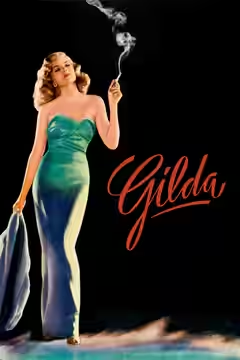
Charles Vidor is worth seeking out for his work with actors, particularly Rita Hayworth. Gilda makes desire feel dangerous, even when the plotting strains; his gift for presenting a star is clearer than his control of the story.
Fi1m perspective
Rita Hayworth makes the desire in Gilda (1946) look difficult to live with. Charles Vidor lets attraction become anxiety and suspicion, while Rudolph Maté’s shadows disturb the film’s polished surfaces. We felt uneasy watching these people want one another, because their longing keeps turning into mistrust. That is Vidor working well: attentive to a performer and to what the lighting can suggest. The film is worth seeing, and Hayworth is the principal reason.
His early Columbia assignments gave way to more prominent productions, including Cover Girl (1944) and the Chopin biography A Song to Remember (1945). This was no narrow specialisation: he worked across comedies, westerns and melodramas as well as musicals. In Cover Girl, Hayworth appears alongside Gene Kelly, whose choreography deserves its share of the credit for the dancing. Vidor’s clear, fluid handling of the numbers, with Maté behind the camera, lets us follow the movement without fuss. It is a useful companion to Gilda, showing his care with performers in a different kind of film.
Gilda also shows why we would be cautious about recommending Vidor by name alone. Its plotting is strained, and the direction sometimes grows stiff despite the attraction between the characters. Hayworth holds our interest, but she cannot make every complication convincing. The film works often enough to merit the evening; the reservations concern Vidor’s storytelling, not a reluctance to accept people behaving foolishly through desire.
Hayworth made four films with Vidor, including The Loves of Carmen (1948), which reunited her with Glenn Ford after Gilda. Later, Love Me or Leave Me (1955) put Doris Day and James Cagney in his hands for the story of Ruth Etting. These changes of cast and genre make it unhelpful to treat every film as another attempt at Gilda. Start with Gilda, then try Cover Girl if the dancing appeals more than the romantic suspicion.
Biography
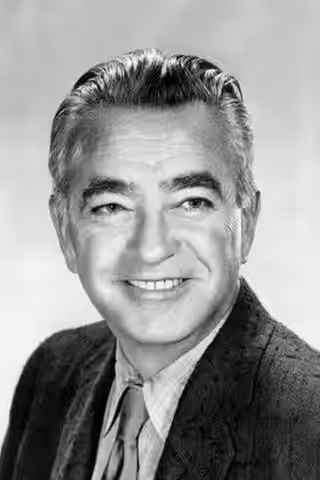
Charles Vidor (also credited as Károly Vidor or Karoly Vidor) was a Hungarian-American film director. Born in Budapest, he served in the Austro-Hungarian Army during the First World War. He began working in films in the final years of the silent era and later moved to Hollywood.
Vidor directed a number of notable films, including the musical Cover Girl (1944), the biopic A Song to Remember (1945), the film noir Gilda (1946), Love Me or Leave Me (1955), The Joker Is Wild (1957) and A Farewell to Arms (1957). He worked extensively with Columbia Pictures in the 1940s and was married to actress Evelyn Keyes and to Doris Warner, daughter of Warner Bros. president Harry Warner.