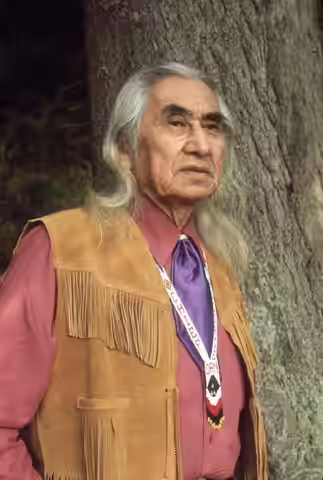
Chief Dan George makes philosophical dialogue sound like something a person has thought about, and leaves room for humour. We value the warmth and patience he brings to films that are not always as restrained.
Fi1m perspective
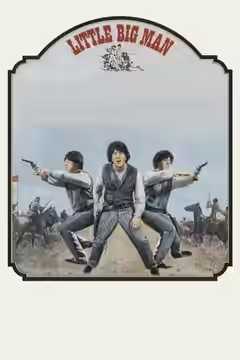
In Little Big Man (1970), Chief Dan George gives Old Lodge Skins time to consider what he is saying. Arthur Penn’s Western can hurry from broad comedy to another explanation of its morals, but George speaks as though these thoughts matter to him personally. We were moved by the dignity of those philosophical passages, because he makes them feel carefully considered rather than delivered for our benefit. His humour helps. He can be funny without making the character seem to exist for the sake of a joke.
His screen career began with Ol’ Antoine in the television series Cariboo Country (1960), with Little Big Man providing the breakthrough in 1970. The later supporting parts include Sam Two Feathers in Harry and Tonto (1974) and Lone Watie in The Outlaw Josey Wales (1976). Such roles gave him room for warmth and dry humour, though he was frequently cast as an elder with counsel to offer. The danger of such a part is that everyone respects the character and nobody writes him much to do.
Penn gives him more space than that, even when the film around him becomes laboured. Dustin Hoffman keeps Jack Crabb’s tall tale moving; George makes us happy to pause with Old Lodge Skins. The contrast works because George does not strain to match the broader comedy, and his warmth survives the changes of tone. This does not make Little Big Man a tighter or less preachy film. It does make the wandering easier to forgive, and gives us a reason to stay through the looser stretches.
Clint Eastwood, who directed and co-starred with him in The Outlaw Josey Wales, allowed latitude when George forgot lines, accommodating his storytelling approach. That seems a sensible way to work with an actor whose appeal depends so much on ease of delivery. Our reservation is how often the roles stop at quiet wisdom; his wit is too useful to leave him merely supplying good advice. Start with Little Big Man for the chance to hear both, provided a wandering Western and some over-explaining do not put you off.
Biography
Chief Dan George (1899–1981) was a Canadian actor, musician, poet and author, and chief of the Tsleil-Waututh Nation, a Coast Salish people, from 1951 to 1963. He began acting in his early sixties after a career that included work as a longshoreman and school-bus driver.
He first gained notice on Canadian television in the series Cariboo Country and its spin-off film Smith! (1969). His breakthrough screen role came as Old Lodge Skins in Little Big Man (1970), for which he received an Academy Award nomination for Best Supporting Actor. He later played Lone Watie opposite Clint Eastwood in The Outlaw Josey Wales (1976).
George was also known for his poetry; his best-known work is the 1974 collection My Heart Soars.