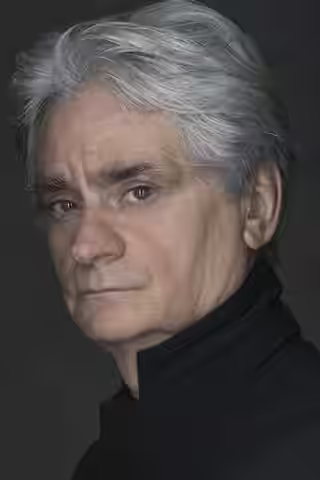
Claudio Bigagli is the man in the crowd the camera happens to find: the groom, the lieutenant, the villager with a suitcase. He has spent four decades playing ordinary Italians overtaken by history, and the Taviani brothers got the best of him.
Fi1m perspective
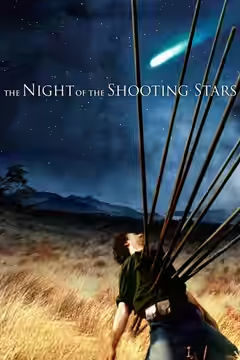
In The Night of the Shooting Stars (1982), Corrado is married on the eve of leaving the village because Belindia is pregnant, and the ceremony is got through by two people who have packing to do. Bigagli plays a groom whose mind is already on the road. We laughed at that wedding, and we laughed because he treats it as one more job to be finished before dark, with no wink at us and no sense that he knows it is funny. That is his method, as far as we have seen it: stand in the column, keep walking, let the film decide when you matter.
He trained at the Silvio D'Amico academy in Rome and started on stage with Dario Fo's company, then made his first film in 1976, Al piacere di rivederla. The Tavianis made him. After Corrado came Batà in Kaos (1984), a man in the grip of something he cannot control, and then Fiorile (1993), and by the end of that run he was one of the most asked-for actors in Italy. In between he turned up for Roberto Benigni in Tu mi turbi (1983), for Nanni Moretti as Ignazio in Bianca (1984), and for Gabriele Salvatores as Lieutenant Raffaele Montini in Mediterraneo (1991), the part most people outside Italy will know him from.
What the auteurs saw in him was a face that reads as anybody's. He is the villager, the officer, the neighbour, the one caught in the war or the strike or the harvest without having asked for it, and he does not push to be noticed. On Batà he has said the work was to get inside the man's soul and his despair, and the sentence tells you what he thinks acting is: not a display but an entry. It is why he sits so well in an ensemble and why we have rarely seen a film built around him. Nobody has quite trusted that quietness to carry two hours on its own, and we would like someone to try.
He has directed two features himself, Il guerriero Camillo (1999) and Commedia sexy (2001), and in later years the casting has changed. The everyman has grown into a suit. For Paolo Sorrentino he played Duilio Guicciardini in The New Pope (2020), and he appears in Mussolini: Son of the Century (2025), the ministers and officials now rather than the men they send off to war. It suits him; the stillness that once read as patience now reads as power held in reserve.
If you know him only from the wedding in The Night of the Shooting Stars, watch the rest of the film and notice how long he stays in the frame after the joke is over. That is where he does his work.
Biography
Claudio Bigagli is an Italian actor born on 8 December 1955 in Montale, Tuscany. He trained at the Silvio d’Amico Academy of Dramatic Arts and began his career in Dario Fo’s stage company. He has appeared in more than 40 films and television productions since his 1976 film debut.
Bigagli’s breakout role came in 1982 as Corrado in The Night of the Shooting Stars, directed by the Taviani brothers, with whom he collaborated on several later films including Kaos (1984) and Fiorile (1993). He is also known for roles in Mediterraneo (1991), Bianca (1984) and Three Steps Over Heaven (2004), and for television appearances in The New Pope (2020) and Mussolini: Son of the Century (2025).
In addition to acting, Bigagli has worked as a playwright and made his directorial debut in 1998 with Il guerriero Camillo.