Colin Bateman writes crime that moves fast and talks too much. His people announce what they are, his plots arrive on time, and his best idea was to build a series around James Nesbitt and let the actor say what the lines could not.
Fi1m perspective
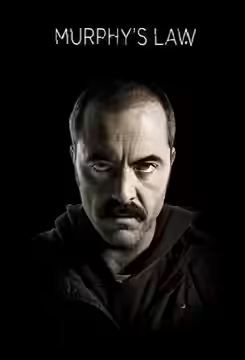
Watch any hour of Murphy's Law (2001) and you will meet the Bateman habit inside ten minutes. A villain explains what he intends to do. A superior states the stakes. Tommy Murphy answers back, and the answer is the best line in the scene because James Nesbitt is the one saying it. Bateman created the series for Nesbitt, and the arrangement suits them both: a writer who likes a flawed man with a quick mouth, and an actor who can make a quick mouth sound like a person. We gave the show 63, and most of those points belong to the lead.
He came to drama from journalism, years on the County Down Spectator, and the pace of a weekly paper is still in the work. The novels came first: Divorcing Jack (1995) and the comic Belfast thrillers that followed, many of them about a journalist called Dan Starkey, with Divorcing Jack turned into a film in 1998. Then television, where he was chief writer on the early series of Murphy's Law and later wrote for Doc Martin, Scúp and Rebus. From about 2016 he moved towards features with the director Nick Hamm, on The Journey (2016) and Driven (2018), and he has since gone back to series with Dead and Buried (2024). Through all of it the subject barely shifts: men on the wrong side of a door, violence and politics in the same room, and a joke arriving before the shock has worn off.
The plotting is what works. The Murphy's Law cases are tight, nasty and resolved within the hour, and we were caught by more than one of them, leaning forward, while wincing at what the people in them were being made to say. That is the trade in Bateman's writing. Incident comes first, description hardly at all, and dialogue is there to move the story along rather than to sound like anything a person would say. It reads well on the page, where the Starkey books live, and it sits awkwardly in an actor's mouth unless the actor is Nesbitt. We have not reviewed the films, but the reviews so far have found much the same in them: engineered encounters, a softness where the material wanted an edge.
He has said that once you have finished a story, you move on to the next one. It is a reporter's discipline, and it is why the plots never stall. It is also why the lines never get a second pass. Nesbitt could carry that for five series; a historical two-hander or a true-crime caper has to carry it alone. We would watch anything he writes for a lead that good. We would be slower to watch anything he writes without one.
Biography
Colin Bateman is a Northern Irish novelist, screenwriter and former journalist. He began his career as a reporter and deputy editor at the County Down Spectator before publishing his debut novel Divorcing Jack in 1995, which won the Betty Trask Award and was adapted into a 1998 feature film.
Bateman created and wrote the BBC television series Murphy's Law (2001–2007), starring James Nesbitt. He has also written screenplays for the films The Journey (2017) and Driven (2019), as well as episodes of series including Doc Martin and Scúp.