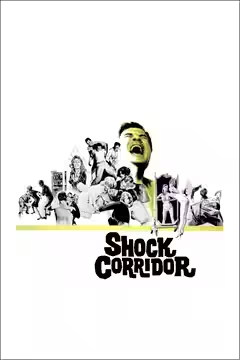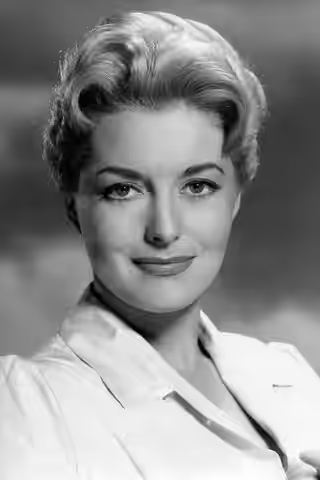
Constance Towers spent the 1950s as a well-bred leading lady in John Ford Westerns, then let Samuel Fuller put her in sequins and make her lie. The Fuller films are the ones to see: she plays shame quietly in pictures where everyone else is shouting.
Fi1m perspective
In Shock Corridor (1963), Constance Towers has two costumes and one job. In the club, Einar Bourman gives her a feather boa and sequins; on the ward, a plain coat. The job is to visit her boyfriend in a mental hospital and tell the doctors he has been making advances to her, because he is a reporter who needs committing for a story and she is the stripper who has agreed to pose as his sister. Towers plays the shame of that lie every time she sits down opposite him. We found those visits harder to watch than anything Fuller stages on the ward, because everyone else in the film is bellowing and she is the only person who looks as though she would rather be somewhere else.
She began as a child radio singer in the early 1940s and made her film debut in Bring Your Smile Along (1955). John Ford noticed her, and used her twice, as the Southern belle Hannah Hunter in The Horse Soldiers (1959), holding her own opposite John Wayne and William Holden, and as Mary Beecher in Sergeant Rutledge (1960), the courtroom Western built around Woody Strode. Ford wanted independent women who could stand among his men without being swallowed by them. Fuller then cast her against all of it, twice: the stripper in Shock Corridor and, a year later, Kelly in The Naked Kiss (1964), a former prostitute trying to start over in a small town.
Those two cheap, loud thrillers are why she has a page here. In Shock Corridor, Peter Breck plays the reporter as a man who speaks in headlines, and Fuller has written him that way; Towers is the one thing on screen that behaves like a person, and the film steadies whenever she is in it. The Naked Kiss has the reputation of being her best film performance, and the people who admire her most tend to point to it first. We have not reviewed it and will not pretend to a verdict. She has said of Fuller: "I have great memories of working with Sam, because he was this wonderful director who communicated with you--and sometimes shocked you. If he felt he didn't have everyone's attention on the set, he shot off a gun he had." You can see the results. Nobody in his films is relaxed.
From the mid-1960s she went to the stage, taking the title part in Anya (1965) and playing Anna opposite Yul Brynner in the 1977–78 revival of The King and I. Then came television, and a great deal of it: Clarissa McCandless for the whole run of Capitol (1982–87), the villainous matriarch Helena Cassadine in General Hospital from 1997, guest parts in Perry Mason, Frasier and Star Trek: Deep Space Nine, and a supporting turn as Gwyneth Paltrow's mother in A Perfect Murder (1998). The later work trades on elegance with something hard underneath it, which is a fair description of what Fuller found in her in 1963.
Start with Shock Corridor. Fuller's script shouts its point at you for ninety minutes; Towers never raises her voice, and she is the one you remember.
Biography
Constance Towers is an American actress and singer. Born Constance Mary Towers on 20 May 1933 in Whitefish, Montana, she studied at the Juilliard School and the American Academy of the Dramatic Arts. She began her career in film in the 1950s with roles in Bring Your Smile Along (1955), The Horse Soldiers (1959) and Sergeant Rutledge (1960).
Towers appeared as Cathy in Samuel Fuller's Shock Corridor (1963) and starred in his The Naked Kiss (1964). She made her Broadway debut in the musical Anya (1965) and later played Anna in a revival of The King and I (1977–78). Her television work includes the soap operas Capitol (1982–87) and General Hospital, where she has portrayed Helena Cassadine since 1997. She received two Emmy Award nominations.