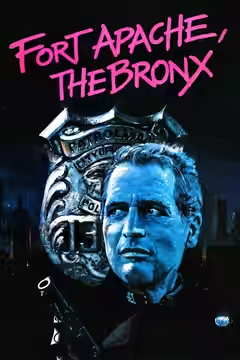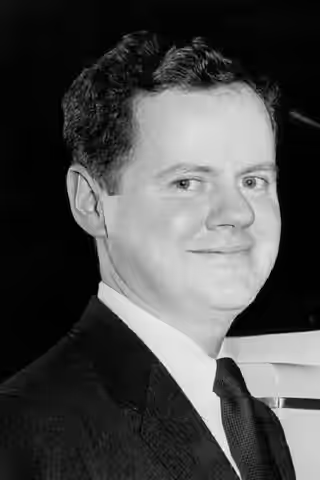
Daniel Petrie put actors in front of hard subjects and let them work, trusted in television and dependable in cinemas. The frame rarely did more than hold them; when the script failed, as in Fort Apache, the Bronx, nothing else took over.
Fi1m perspective
The first thing that happens in Fort Apache, the Bronx (1981) is two rookies in a patrol car, a woman in a red dress and two shots, and the camera does not flinch. We were shaken by it, and we spent the next half hour waiting for the film about those two dead boys. It does not come. That is Daniel Petrie in miniature: a director who could put a hard thing on screen without looking away, and who then relied on somebody else to have decided what the film was about.
He came out of live television in Chicago in the early 1950s and never really left the medium, whatever the credits say. The features began with The Bramble Bush (1960), and A Raisin in the Sun (1961), with Sidney Poitier, made his name. The subjects he took on over the next forty years were the ones other directors stepped around: abuse and multiple personality disorder in Sybil (1976), the Roosevelts in Eleanor and Franklin (1976), a woman with healing powers in Resurrection (1980), a woman keeping her family fed in The Dollmaker (1984). His own boyhood in Glace Bay, Nova Scotia, went into The Bay Boy (1984), which he wrote as well as directed. He was still making television films in 1999, with Inherit the Wind, and stopped around 2001.
What critics have always noticed, and what we noticed in the Bronx, is the acting. Paul Newman gives him a fine, tired, decent performance in a film with no plot to put it in. Ellen Burstyn, Sally Field, Jane Fonda, Poitier: the list of people who did strong work for him is long, and it is not luck. His own account of the job was this: "You try to make a project director proof, and that means that no matter what kind of screw-ups you are responsible for, none-the-less, if you cast it really well, if you really worked on the script really well, then you can get away with murder." It is a modest description of directing, and it tells you where his attention went.
The cost of that modesty is that the camera seldom has an idea of its own. Critics have said of A Raisin in the Sun that it is stage-bound for all its cast, and the complaint followed him through the features, which were never where his reputation lived. Television suited him: a biographical or issue-driven story, a strong lead, no need for the frame to carry weight. In a cinema, with a script that had not finished its thinking, as Heywood Gould's had not in the Bronx, he delivered a string of shifts and nobody to add them up.
If you want to see what he was good at, the television films are where the material was chosen for him and he chose the people. Fort Apache, the Bronx is worth an evening for Newman and for that opening, and you will know within half an hour whether the loose shape is going to bother you.
Biography
Daniel Petrie (also credited as Daniel Mannix Petrie) was a Canadian film and television director. Born in Glace Bay, Nova Scotia, he moved to the United States in 1945 and began his career in television before directing feature films.
His notable films include A Raisin in the Sun (1961), Resurrection (1980), Fort Apache, the Bronx (1981) and Cocoon: The Return (1988). He also directed television movies such as Sybil (1976) and the Eleanor and Franklin films, winning Emmy Awards for directing. Petrie wrote and directed the 1984 autobiographical film The Bay Boy.
Petrie died of cancer in Los Angeles in 2004 at the age of 83. He is survived by his wife Dorothea and children including sons Daniel Petrie Jr. and Donald Petrie, both writers and directors.