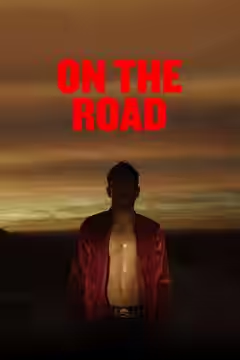
David Pablos makes films about bodies that are bought, sold and watched, and he shoots them so the watching is the danger. Four features in, On the Road (2026) is his loosest and, we think, his best, worth an evening if your stomach is strong.
Fi1m perspective
The scene we keep coming back to in On the Road (2026) has nothing happening in it. Two men wash in a truck-stop shower block with the door open, and other drivers walk past without slowing. Pablos holds on the doorway and does not cut. By then the film has taught us what these men are to the men around them, and that was enough: an open door frightened us more than anything the film does later with a weapon. It is a horror technique used in a romance, and it tells you most of what you need to know about how he works.
He came up through short films and documentaries from 2007, out of the Centro de Capacitación Cinematográfica in Mexico City, and the features have kept a documentary habit. He casts non-professional actors after workshops, particularly for stories set in working-class Mexico, and the performances he gets from them do not look like acting. La Vida Después (2013) was a family under strain. Las elegidas (2015), which he also wrote, was about sex trafficking in Tijuana, where he was born. El baile de los 41 (2020) restaged a 1901 scandal with a cast that mixed professionals and amateurs, and he has since directed episodes of the series The Head of Joaquín Murrieta (2023).
What connects the films is the subject and the camera. The subject is desire, mostly male, and the hostility waiting around it, usually somewhere on a road or a border. The camera moves with the people and watches them; he has said he admires filmmakers "using the camera as an expansive tool", and in his hands that means the cab of a truck shot so the highway seems to close in on it, and a shower block framed so the frame itself is the threat. He is exact about composition, and the exactness is where the feeling comes from.
He is less good at the past than the present. The motif of a damaged boyhood standing behind a damaged man has been noticed before as something he returns to too often, and in On the Road the cutaways to Veneno as a child with his father explain what Victor Prieto Simental's face had already told us. His second halves also tighten into thriller machinery, and the men who drive that machinery, El Eulas and El Pelón, are types where the lovers are people. The producer Pablo Cruz has been with him for three films and Inna Payán for two; Diego Luna is among the producers of On the Road, and the film has the roadside Mexico of the pictures Luna made his name in, minus any of the comfort.
Start with On the Road, and at home only if you are not easily embarrassed; the sex is frank and Pablos does not look away. The question for whatever comes next is whether he trusts his own actors' faces enough to stop explaining them.