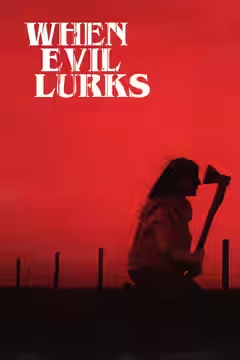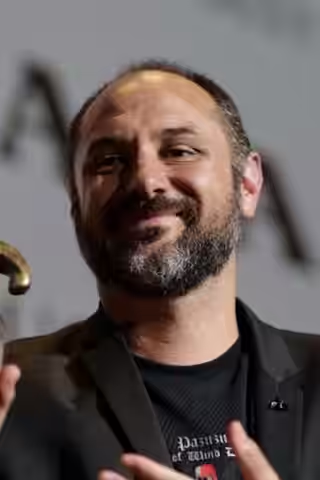
Demián Rugna makes horror in which the demon is a disease, caught in a field and mishandled by the people who find it. He builds a first hour as well as anyone in the genre; the last half hour still needs work.
Fi1m perspective
A demon, in a Demián Rugna film, is something you catch. It gets into a body and festers there for months, and the people who find it are not priests but farmers, who handle it the way farmers handle a sick animal: badly, in a hurry, and with a gun. That is the founding idea of When Evil Lurks (2023), and it tells you most of what you need to know about him. He has no interest in the crucifix or the Latin. He wants to know what happens to a village when the thing in the barn is contagious and nobody from the ministry is coming.
He came to features slowly. After short horror films in the early 2000s there was The Last Gateway (2007), then Cursed Bastards (2011), co-directed with Fabián Forte, and You Don't Know Who You're Talking To (2016), none of which travelled far. Terrified (2017) did, and found him an audience outside Argentina; a segment for the anthology Satanic Hispanics (2022) followed. When Evil Lurks is his fifth feature and the one his reputation now rests on, and it deserves the weight.
What he does well is the set piece that means it. Early in When Evil Lurks there is a scene involving a dog that we will not describe, and we watched it with a hand over our mouths, because Rugna neither cuts away nor lingers: his editor Lionel Cornistein holds the shot exactly as long as it takes to understand what has happened, then goes to the faces of the people who saw it. Rugna has said that the audience needs to know he is prepared to do something terrible, and that scene is the proof. After it, no rule he lays down feels safe, and that is the point. The effects are practical, the humour is black, and he will switch from one to the other without warning.
He keeps the same small crew around him, with Mariano Suárez shooting, Cornistein cutting, Laura Aguerrebehere on design and Demián Salomón in the cast, and the consistency shows. Salomón, in When Evil Lurks, is the brother who keeps his mouth shut and his eyes open, and he is exactly the kind of actor Rugna's films need: someone who has heard the old warnings and half believes them.
What he does less well is the ending. When Evil Lurks frightened us more than anything we had sat through in years and then loosened, the rules bending when the plot needed them to, a character knowing what he could not have known, a climax hurried through as if Rugna feared we might stop believing. Most reviews have said something similar of him, that strong openings are followed by uneven structure, and on the evidence we have they are right. He can start a horror film as well as anyone alive. If the next one holds its nerve past the ninety-minute mark, we will be telling strangers about it.
Biography
Demián Rugna is an Argentine film director, screenwriter and editor specialising in horror. Born on 13 September 1979 in Haedo, Buenos Aires Province, he graduated in graphic design from the Universidad de Morón in 2003. He began by making short films and directing his first feature, The Last Gateway, in 2007.
Rugna’s second feature was the 2013 co-directed Cursed Bastards. He achieved wider recognition with Terrified (2017), which won Best Picture in the horror category at Fantastic Fest, and When Evil Lurks (2023), which he wrote and directed. The latter premiered at the Toronto International Film Festival and won Best Feature at the Sitges Film Festival. He also directed a segment of Satanic Hispanics (2022).