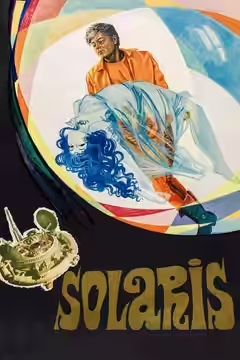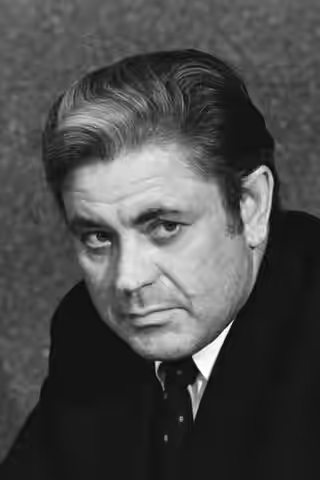
Donatas Banionis can make a silent, watchful man worth sustained attention. We value the restraint that makes his Kris Kelvin so hard to reach in Solaris, while sometimes wishing he would let us closer.
Fi1m perspective
In Solaris (1972), Donatas Banionis makes Kris Kelvin difficult to know even while he is speaking. His reserve suits a man sent to investigate a planet whose behaviour defeats explanation, only to find human memories and needs getting in the way. We value the performance’s reluctance to make Kelvin easily approachable. Andrei Tarkovsky has an actor who can hold our attention without making his thoughts immediately available. There are limits: in some conversations, that guardedness makes the scene feel longer than the thought behind it.
Kelvin can make the rest of the screen career too easy to overlook. His breakthrough as Vaitkus in Nobody Wanted to Die (1965) was followed by the popular spy role of Ladeinikov in Dead Season (1968). He went on to play Francisco Goya in Goya or the Hard Way to Enlightenment (1971) and Ludwig van Beethoven in Beethoven – Tage aus einem Leben (1976). He remained primarily a stage actor throughout a screen career that included psychological dramas, spy films and biopics. The recurring screen figure was a reserved, thinking man who watched more readily than he acted.
His voice needs a little care when discussing that work. His Lithuanian accent led to dubbing in most of his Russian-language films, so we should not automatically credit him with every vocal inflection. The intense stare, the timing and the reserved physical presence are more reliable things to attend to. That makes him well suited to Kelvin, whose difficulty in communicating is something the film can make us feel before it starts explaining it.
With Natalya Bondarchuk’s Hari in Solaris, that distance becomes emotionally useful. We were moved by the contrast between her readily felt hurt and his difficulty in letting anyone close. Bondarchuk supplies much of the feeling, and the film is stronger for allowing her performance to do what Kelvin’s reserve cannot. The long philosophical conversations sometimes explain what the two actors have already made clear, which is our chief caveat about a film we warmly recommend. For a first encounter, choose Solaris on an evening when nobody is in a hurry.
Biography
Donatas Banionis (28 April 1924 – 4 September 2014) was a Lithuanian stage and film actor and theatre director. He was born in Kaunas and trained at the acting studio of the Panevėžys Drama Theatre under Juozas Miltinis, graduating in 1944. He remained associated with the theatre for much of his career, appearing in over 100 stage roles, and later studied at the Lithuanian State Conservatory.
Banionis made his film debut in the late 1940s and went on to appear in more than 80 cinema and television roles, often in Russian-language productions. He is best known for playing Kris Kelvin in Andrei Tarkovsky's Solaris (1972). Other notable films include Nobody Wanted to Die (1966), Dead Season (1968), The Red Tent (1969), Goya or the Hard Way to Enlightenment (1971) and Beethoven – Days of a Life (1976).
He was named People's Actor of the USSR in 1974 and received various state awards in Lithuania and the Soviet Union.