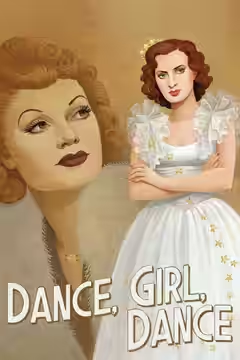
Dorothy Arzner takes women's ambitions seriously, especially when their work involves being looked at. We value that attention, though the uneven Dance, Girl, Dance shows how easily conventional romance can distract her from the more interesting story.
Fi1m perspective
In Dance, Girl, Dance (1940), a performer's appearance helps determine her prospects. Edward Stevenson's costumes make that scrutiny part of the drama, and Arzner gives the women's rivalry weight by taking their ambitions seriously. She understands that wanting success can be a reasonable response to the demands of the job. That interest in women trying to do something for themselves is central to her cinema. We value it, while finding the film's comedy and romance considerably less persuasive.
Arzner came to directing through editing and script work, making her first feature, Fashions for Women, in 1927. For The Wild Party (1929), the boom microphone allowed Clara Bow greater freedom to move during sound filming. This was technical resourcefulness directed towards a performer's needs. She also preferred having writers on set and collaborated repeatedly with screenwriter Zoë Akins, working closely on the development of female characters.
She left Paramount to freelance in 1932, making films for several other studios. Christopher Strong (1933) gave Katharine Hepburn an early lead as an independent aviator, while Craig’s Wife (1936) stressed the wife's pursuit of independence. These are different settings for women whose choices matter to the director. Friendship between women recurs across her work, complicating the familiar competition for attention rather than assuming they can only be rivals.
None of that excuses a story that keeps losing its way. We were frustrated by Dance, Girl, Dance because the romance repeatedly interrupted its more interesting account of women's professional ambitions. Arzner takes the conditions attached to success seriously, but that attention cannot make the romantic distractions any more compelling. Lucille Ball is a substantial reason to stay with it, and our qualified recommendation rests as much on her as on the director's concerns. Try it for Ball and the women's working lives, with modest expectations for the love story.
Biography
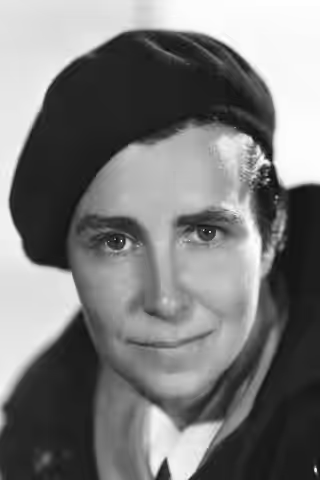
Dorothy Emma Arzner was an American film director. She worked in Hollywood from the silent era into the early 1940s and was the only woman directing feature-length studio films there during the 1930s.
Arzner began her career at Paramount as a typist and editor before directing her first feature, Fashions for Women, in 1927. She directed The Wild Party (1929), Paramount’s first sound film, and went on to make around seventeen features. Her credits include Merrily We Go to Hell (1932), Christopher Strong (1933), Craig’s Wife (1936) and Dance, Girl, Dance (1940). She was the first woman to join the Directors Guild of America.
Arzner retired from feature directing after First Comes Courage (1943). She later taught filmmaking and directed training films and commercials.