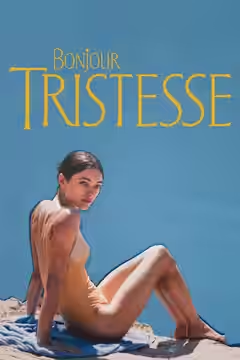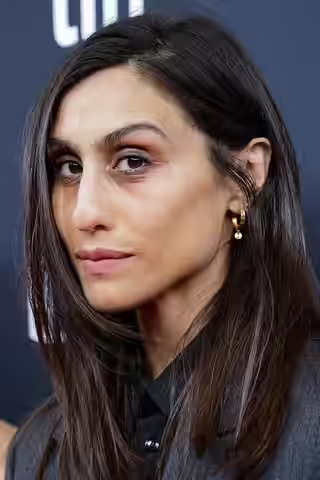
One film in, Durga Chew-Bose directs the way she wrote essays: patiently, and exact about light, rooms and long looks across a lunch table. Bonjour Tristesse is a pleasure to sit in. What it lacks, so far, is the nerve to be unkind.
Fi1m perspective
A girl on a terrace, watching. That is the image Durga Chew-Bose keeps coming back to in Bonjour Tristesse (2025), and it is both her gift and her problem. Cécile notices the way the light falls on a swimsuit drying over a chair, the way her father laughs at something that is not funny, the way a guest pours a drink, and then she goes for a swim. The camera has done its job. The story has not.
Chew-Bose came to directing sideways. She was an essayist and critic first, with a collection, Too Much and Not the Mood, in 2017, and the producers Katie Bird Nolan and Lindsay Tapscott approached her only to write the adaptation of Françoise Sagan's novel. Nearly eight years later she had directed it. Her stated references were Edward Yang, Lucrecia Martel and the photographer Luigi Ghirri rather than the usual Riviera postcard, and it shows: the film looks at a villa the way Ghirri looked at a wall, more interested in the object than the drama in front of it.
That is the right instinct for the first hour. She moves Sagan's 1954 summer to the present and slows it to a drift, and the terrace lunches, the swims and the silences are handled with a confidence most first films do not have. Chloë Sevigny is quietly excellent, and Harzoune's Elsa is warmer and sharper than the part usually gets, so the film wakes up whenever she is about. We were content for that hour, properly content, in the way one is on the third day of a holiday. Then we began waiting for something to break, and nothing did.
The something is jealousy, and Chew-Bose's script does not have it. Sagan's Cécile is clever, spoilt and frightened, and does a thing she knows is unforgivable. McInerny's Cécile is watchful and likeable and never dangerous, because the writing gives her observations rather than wants. Bang plays Raymond as charm without weight, so we never believed he would change for Anne and never believed Cécile had anything to lose. Otto Preminger's 1958 version, whatever its faults, knew this was a story about cruelty. Most critics have been warmer about the film than we were, and we understand why: as a debut it is unusually sure of its surfaces. It is the middle of it that is missing.
One film is a small sample, and Chew-Bose has said she does not do five-year plans and does not expect each thing she makes to be a rung on a ladder. Good. The next one will tell us whether the shyness about meanness is a temperament or a first-timer's caution. We would like it to be the second, because a director who can make a room look like that and is also willing to let someone behave badly in it would be worth following.
Biography
Durga Chew-Bose is a Canadian writer and film director. Born in Montreal in 1986, she studied at Sarah Lawrence College and spent a year at the University of Oxford. She has written essays and criticism for publications including The Guardian, BuzzFeed, The New York Times and others.
Her first book, the essay collection Too Much and Not the Mood, was published in 2017. She made her feature directorial debut with Bonjour Tristesse (2025), which she also wrote. The film is an adaptation of the Françoise Sagan novel and premiered at the Toronto International Film Festival in 2024.