Edward Yang makes room for whole families without losing sight of the hurt of one schoolboy. His films demand attention, but we value their patience and their tenderness towards people whose failings he sees quite clearly.
Fi1m perspective
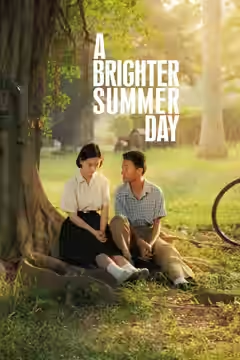
The father in A Brighter Summer Day (1991) walks his bicycle home beside his son after a row at school. He tells the boy that hard work and belief in himself will keep fear away. We were quietly undone by the scene, because Yang lets the reassurance stand even as we suspect the father knows it is untrue. Yang lets us doubt the advice without asking us to look down on the man giving it.
The film follows Chang Chen's Xiao Si’r into night school and the company of schoolboy gangs in early-1960s Taipei. Yang writes with Alex Yang, Mingtang Lai and Hung Hung, keeping the family in view alongside the gangs. Xiao Si’r's mother is a teacher whose mainland qualifications are not recognised, a family grievance the film takes seriously. Chang makes a tightened jaw or a hand left in a pocket worth watching. Lisa Yang's Ming adjusts to the people around her, without telling us how deliberately she does it.
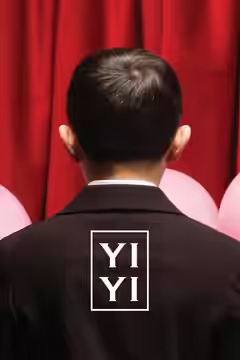
The early features put adults under a similarly close watch. That Day, on the Beach (1983) was his feature debut, photographed by Christopher Doyle; Taipei Story (1985), starring Hou Hsiao-hsien, studies a relationship amid the city's transformation. The turn to satire in A Confucian Confusion (1994) and Mahjong (1996) brings business, money and exploitation to the fore. Those comedies can be abrasive, and less sure of their tone than his family films. His final film, Yi Yi (2000), follows several generations over a year.
He often holds his shots and places people apart within the frame, with doorways doing some of the separating. We have time to notice who is being kept at a distance, though the restraint can feel chilly in Terrorizers (1986). A Brighter Summer Day needs close attention, not least because there are so many schoolboys to keep straight, and the length will put some people off. Start with its 237 minutes if there is an uninterrupted evening to spare; Yi Yi can have the next one.
Biography
Edward Yang, also credited as Yang Dechang, was a Taiwanese filmmaker born in Shanghai in 1947. He studied electrical engineering at National Chiao Tung University and the University of Florida, then worked in the computer industry in Seattle. After seeing Werner Herzog's Aguirre, the Wrath of God, he turned to film, returning to Taiwan to direct his first feature, That Day, on the Beach (1983).
Yang was a leading figure in the Taiwanese New Wave. He wrote and directed A Brighter Summer Day (1991), an epic set in 1960s Taipei, and Yi Yi (2000), a family drama that earned him the Best Director award at the Cannes Film Festival. Other films include Taipei Story (1985), The Terrorizers (1986), A Confucian Confusion (1994) and Mahjong (1996). He became an American citizen and died in Beverly Hills in 2007.