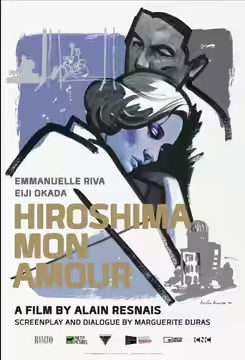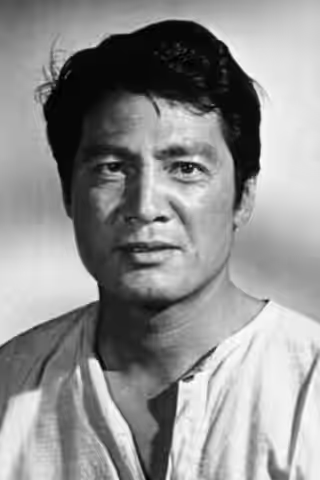
Eiji Okada makes the effort of listening worth watching. His work in Hiroshima Mon Amour is patient and affecting, keeping the attraction alive without pretending that either person can easily understand the other.
Fi1m perspective
In Hiroshima Mon Amour (1959), Emmanuelle Riva's Elle keeps trying to speak, and Eiji Okada's Lui gives her words someone to reach. His part depends on sustaining the attraction without suggesting that understanding will follow if they only talk long enough. It is a finely judged performance, generous to Riva and alert to the difficulty between the characters. We were moved by their exchanges because Okada makes her repeated efforts to explain herself feel worth making, even when speech seems to be getting her nowhere.
His first film was Until the Day We Meet Again (1950), and the ensuing decade included dramas directed by Tadashi Imai. Alain Resnais's Hiroshima Mon Amour brought international recognition. Okada learnt its French dialogue phonetically, without speaking the language. That is striking preparation, but the relationship with Riva matters more to us than the difficulty of the task. Some dialogue is overworked; the actors keep its repetitions rooted in the effort to communicate, giving us a reason to stay with the questions about memory.
Hiroshi Teshigahara's Woman in the Dunes (1964), adapted from Kōbō Abe, gives that introspection a harsher setting. Okada plays Niki Jumpei, an entomologist trapped in circumstances he has to learn to live with. His work in this period also included a Hollywood role opposite Marlon Brando in The Ugly American (1963). With Teshigahara and Abe again, he took the supporting role of the Boss in The Face of Another (1966).
The later career includes character parts in Lady Snowblood (1973) and Sidney Pollack's The Yakuza (1974). We would not recommend every film on the strength of his presence, or mistake the length of the credits for a measure of the acting. Begin with Hiroshima Mon Amour, and give the person listening as much attention as the person speaking.
Biography
Eiji Okada was a Japanese film actor. He was born on 13 June 1920 in Chōshi, Chiba, and died on 14 September 1995 in Japan.
Okada served in the Japanese army during the Second World War. Before becoming an actor he worked as a miner and a travelling salesman. His first film role came in 1950. He appeared as Lui in Alain Resnais's Hiroshima Mon Amour (1959) and as the entomologist Niki Jumpei in Hiroshi Teshigahara's Woman in the Dunes (1964). Other notable credits include The Face of Another (1966), Lady Snowblood (1973) and The Yakuza (1974).
Okada was married to Aiko Wasa, with whom he ran a theatre company in Japan.