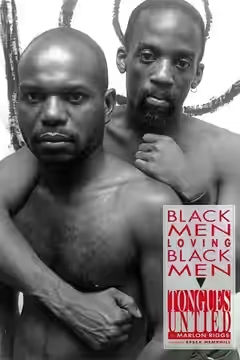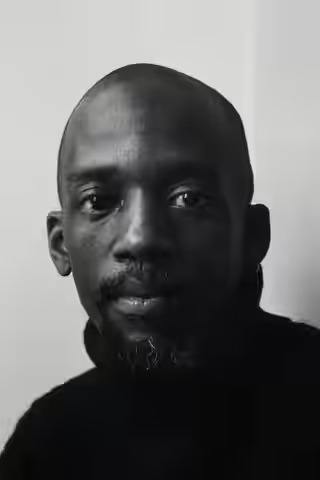
Essex Hemphill’s poetry needs little embellishment on screen. In Tongues Untied, we value his plain delivery and candour about Black gay life, even when the film around him grows stagey.
Fi1m perspective
In Tongues Untied (1990), Essex Hemphill reads his poems flatly, without putting on a performance for the camera. We were moved by those readings: he sounds as though he needs to be heard, not congratulated. That restraint gives the writing room, and makes him one of the reasons we recommend Marlon Riggs’s film. His recurring subjects include desire, loneliness and the difficulty of finding acceptance as a Black gay man. The unforced delivery makes these concerns feel close, without requiring him to raise his voice.
His work had already moved between the page and live performance: the early-1980s group Cinque brought him together with Wayson Jones and Larry Duckette, and he self-published Earth Life (1985) and Conditions (1986). His poetry also featured in Isaac Julien’s Looking for Langston (1989), while Black Is… Black Ain’t (1994) brought another collaboration with Riggs. These contributions make sense for a writer accustomed to working with other performers. His broader work includes theatrical monologues and sexually candid poems. The restraint of his readings in Tongues Untied is worth noticing precisely because he had other ways of addressing an audience.
Riggs shoots Tongues Untied with Vivian Kleiman and edits it himself, bringing spoken testimony, poems and dance into the same film. The film also includes men demonstrating the vocabulary of finger snaps, while Willi Ninja vogues. The variety keeps the poetry from making the film feel like a recital with pictures attached. Hemphill can remain unshowy because the dancers, speakers and editing already give the film movement. Riggs makes space for a quiet reading without draining the humour from the performances elsewhere.
Tongues Untied can look rough, and some of its staging is stiff; our admiration for Hemphill does not smooth that away. Nor should his contribution obscure the other credited writers, who include Joseph Beam, Donald Woods and Reginald Jackson. This is shared work, and we would not attribute all its directness to one poet. Hemphill’s measured readings are nevertheless a substantial reason it holds our attention. Start here, allowing for a little theatrical awkwardness along with the candour.