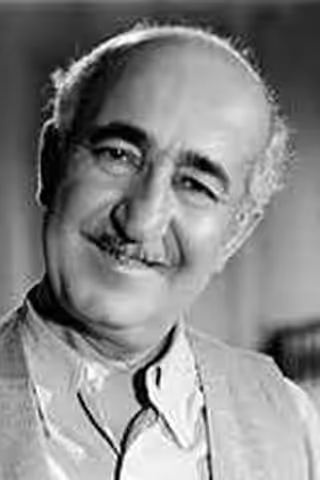
Fernand Charpin gives merchants and notables an easy conversational authority, with room for comedy. We value his work in Pagnol's ensembles, though Pépé le Moko is a welcome departure from the reassuring parts.
Fi1m perspective
Fernand Charpin brings a stocky build, an expressive face and a southern French accent to men who expect to be taken seriously. Merchants, officials and fathers suit an actor whose authority can accommodate a joke. We value the ease with which he fits into Pagnol's long conversations. He is effective when the scene needs several people talking naturally, without each speech being treated as a little solo.
His Panisse runs through Marius (1931), directed by Alexandre Korda, Fanny (1932), directed by Marc Allégret, and Pagnol's César (1936). The role began on stage and made him central to Pagnol's Marseille ensemble. For a fuller acquaintance than a single supporting appearance allows, these are the films to seek out.
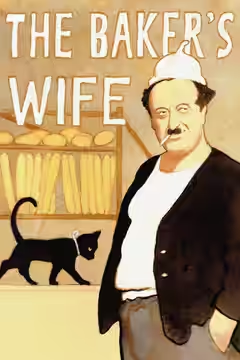
In Marcel Pagnol's The Baker's Wife (1938), Charpin plays the Marquis Castan de Venelles, a comic authority figure among the villagers. He suits this company, but Raimu's baker is the reason the film's unhappiness matters. We were moved by the baker's hurt because Raimu lets it persist beneath the jokes. Charpin's contribution belongs to the surrounding comedy, and there is no need to pretend he is the film's centre. Some of that village humour wears thin, while the conservative filmmaking does little to help it along.
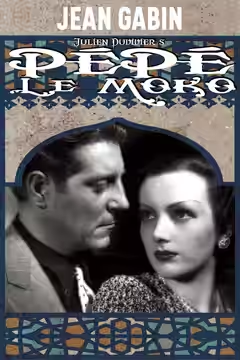
Julien Duvivier finds a less comfortable place for him as Régis, an informer, in Pépé le Moko (1937). The departure matters: an actor so associated with Pagnol's company need not offer reassurance. Jean Gabin's close-ups and the Casbah's shadows supply much of the film's emotional force, although the leisurely passages ask for patience. Charpin is worth noticing here because the casting complicates an easy account of him as a genial southern comic.
Later casting too often returned him to mayors, judges and other notables. That repetition limits what the films ask of him, even when he is well suited to the job. Start with Panisse for the sustained acquaintance; try Pépé le Moko before deciding that warmth was all he had.
Biography
Fernand Charpin was a French actor. Born in Marseille in 1887, he trained at the Conservatoire and began his career on stage, performing classical repertoire and becoming a regular at the Théâtre de l'Odéon.
He met Marcel Pagnol and Raimu in 1928 and originated the role of Honoré Panisse in Pagnol's play Marius (1929). He reprised the part in the film adaptations Marius (1931), Fanny (1932) and César (1936). Charpin appeared in numerous other French films of the 1930s and 1940s, including Pépé le Moko (1937) as Régis, La Belle Équipe (1936), La Femme du boulanger (1938) and La Fille du puisatier (1940).
He died in Paris in 1944.