A lifetime of bishops, judges and monks at the edge of Mexican frames, and one lead shot on and off for twelve years and never finished. Reiguera's face carries Welles's Don Quixote; the film around it does not deserve him.
Fi1m perspective
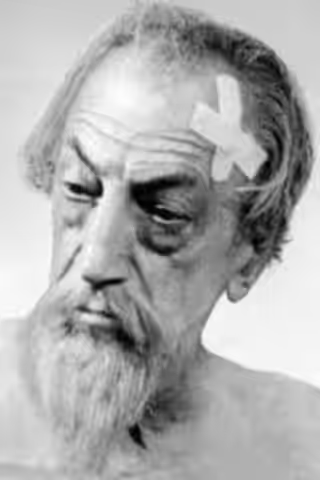
Look at the eyes first. In Don Quixote (1992) Francisco Reiguera plays the knight as a man who has already decided what he is looking at before he looks, and the century around him, all tarmac and scooters, simply fails to register. The face does the work: hollow cheeks, a beard like frayed rope, a profile as thin as a blade. He does not act mad. He acts certain, which is harder and funnier and sadder.
That certainty was the end of a long apprenticeship in standing at the edge of the frame. Reiguera started as a child actor in Madrid at eight, was a bit player and extra in silent-era Europe and Hollywood from around 1913, and moved to Mexico in 1940, where he became one of the most prolific character actors of the Golden Age: over a hundred films between 1942 and his death in 1969, most of them as judges, bishops, monks, mayordomos and doctors. He worked for Emilio Fernández and Fernando Cortés, and for Luis Buñuel as the old monk in Simon of the Desert (1965). He directed twice and wrote scripts. A great many of the parts were small and uncredited, and a great many of the films are forgotten.
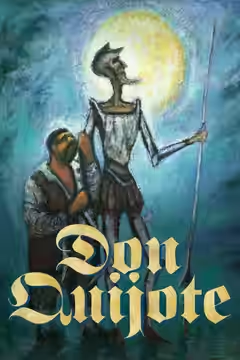
Then, in 1957, Orson Welles asked him to be Don Quixote, and kept asking, on and off, until shortly before Reiguera died. The footage sat unfinished until Jesús Franco assembled it in 1992, and the result is muddy, badly dubbed and often a slog. Twice, though, it comes close to greatness, and both times it is Reiguera who gets it there. Charging a flock of sheep with the camera down among the animals, he makes us believe in the army for a few seconds. Riding at the windmill, with Welles cutting between the blades and his face, he plays the defeat as a victory, and we were moved by him far more than we expected to be, because for once the camera took the old man's side.
Against him is everything else. Akim Tamiroff's Sancho is a proper partner, round and put-upon, but the voices are not theirs: Pepe Mediavilla dubs Reiguera over a mouth filmed years earlier, and the words often do not fit. So the one lead performance of a career that began before the First World War survives with its face and without its voice, in a film assembled twenty-three years after he died.
It is fair to say his reputation rests almost entirely on that unfinished project, and that a hundred supporting parts do not add up to a body of work a viewer can trace from a sofa. Go to Simon of the Desert for the authority he brought to a monk in a good film, and to Don Quixote for the windmill. Bring patience for the rest. The man spent his life as the bishop in the corner; when he finally got the middle of the picture, the picture fell apart around him.
Biography
Francisco Reiguera (also credited as Paco Reiguera) was a Spanish actor. Born in Madrid, he began his career as a child actor in theatre and worked in silent films in Europe and Hollywood before emigrating to Mexico in 1940.
He appeared in over 100 films, primarily as a character actor during the Golden Age of Mexican Cinema, with credits including Simon of the Desert (1965), Major Dundee (1965), Viva Maria! (1965), Guns for San Sebastian (1967) and El analfabeto (1961). He played the title role in Orson Welles’ unfinished adaptation of Don Quixote, with footage later used in the 1992 release.