Frank Tashlin writes for bodies as much as voices, giving comedians a brightly coloured world fit for their exaggerations. We enjoy his visual invention, but his jokes often continue after they have stopped being funny.
Fi1m perspective
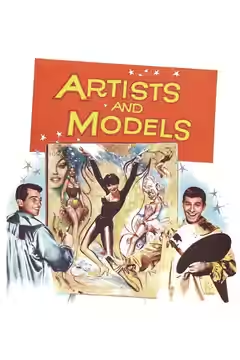
In Artists and Models (1955), Jerry Lewis’s Eugene Fullstack has a comic-strip obsession, and Frank Tashlin gives the film the bright colour and exaggeration to match. Children are being offered violent fantasies, while the adults hardly seem able to keep them in proportion. We laughed at Eugene’s fixation, then felt uneasy about what was feeding it. Tashlin makes that unease part of the comedy without stopping to deliver a lecture.
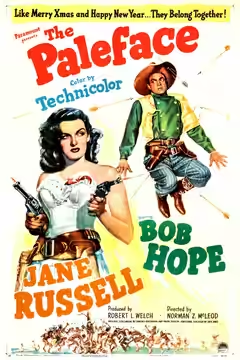
Tashlin brought an animator’s experience to live-action gag writing and screenplays in the mid-1940s. In The Paleface (1948), his script with Edmund Hartmann makes good use of Bob Hope’s wisecracks and Jane Russell’s drollness. He knows how to write for a particular performer, though here the supply of fresh jokes cannot quite keep up. The comedy returns to the same pleasures until they begin to wear thin. That is a limitation worth remembering when praising his invention.
He began directing features in 1952, carrying animation’s rapid pacing, unusual camera angles and elastic physical comedy into live action. The interest in popular culture extends from the comic books of Artists and Models to the rock ’n’ roll and celebrity of The Girl Can’t Help It (1956). Will Success Spoil Rock Hunter? (1957) turns to advertising and fame. These subjects suit a writer whose exaggerations can be funny and uncomfortable in the same scene.
In Artists and Models, Daniel L. Fapp’s bright colour makes the physical exaggeration feel at home, and the pictures sometimes outdo the jokes. Warren Low’s editing keeps the bustle moving, but the screenplay Tashlin shares with Hal Kanter and Herbert Baker allows routines to carry on after their comic value has run out. The spy complications are less rewarding than the comic-strip fixation, and 110 minutes leaves plenty of room for fatigue. Still, the film gives Lewis’s frantic energy a purpose, rather than merely indulging it. Start there, provided broad physical comedy is your sort of evening and you can forgive a film for not knowing when to stop.
Biography
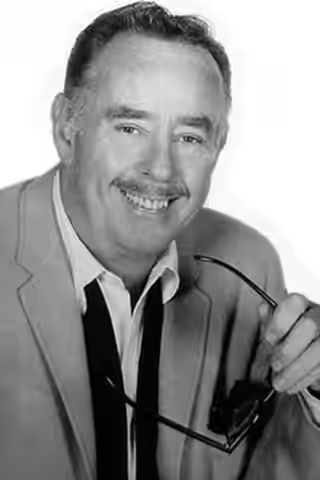
Frank Tashlin (born Francis Fredrick von Taschlein) was an American animator, screenwriter and film director. He began his career in animation, working on Looney Tunes and Merrie Melodies shorts for Warner Bros. in the 1930s and 1940s.
Tashlin later wrote screenplays for live-action comedies, including The Paleface (1948). He made his directorial debut with The First Time (1952) and went on to direct a series of popular films, among them Artists and Models (1955), The Girl Can't Help It (1956), Will Success Spoil Rock Hunter? (1957), Rock-a-Bye Baby (1958) and Cinderfella (1960). He died in 1972.