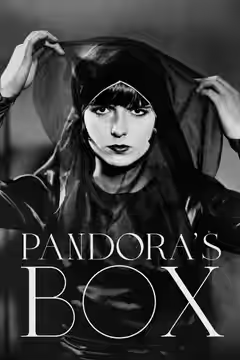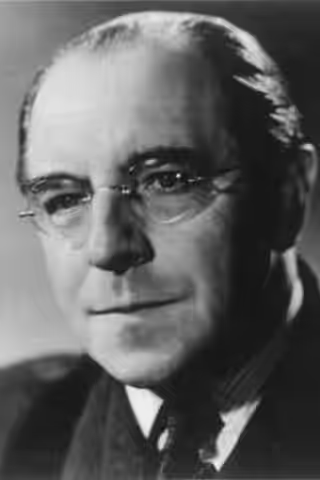
Pabst makes people under pressure worth watching, especially the women whom everyone else is busy judging. We recommend him for his handling of actors and his fluid cutting, with a reservation about the moralising in Pandora’s Box.
Fi1m perspective
In Pandora’s Box (1929), Kortner’s Schön locks his jaw and works his hands while Louise Brooks’s Lulu seems scarcely to be acting at all. We were delighted by her ease beside his visible strain. Pabst lets that difference remain: the men can look emphatic without making the woman at the centre look unreal. His direction of actors and his fluid cutting help make this a silent film we would readily recommend to anyone wary of silent acting. The middle sags and the moralising grates, but Brooks gives us ample reason to stay.
Before Brooks, Joyless Street (1925) established his interest in people under economic pressure through its depiction of inflation-era Vienna. Dreams and the unconscious became the subject of Secrets of a Soul (1926), and Brooks was also central to Diary of a Lost Girl (1929). He was among the early directors to shape performances specifically for the camera, paying attention to what it could register. His habit of cutting on movement helped him move between shots without distracting us from the people in them.
Pandora’s Box was written by Pabst with Ladislaus Vajda and its editor, Joseph Fleisler, and its treatment of Lulu’s companions is uneven. Carl Goetz’s Schigolch gets a sly comic life of his own; Francis Lederer’s Alwa has little beyond a boy’s adoration. More troubling is Alice Roberts’s Geschwitz, who wants Lulu for herself and is kept at the edge of the frame. There is room here for more of her and rather less of the men.
His move into sound brought Westfront 1918 (1930) and Kameradschaft (1931), with overlapping dialogue and careful integration of sound and image. The later work attracted complaints of inconsistency and too much readiness to follow prevailing styles. That leaves us cautious about recommending the entire career, but enthusiastic about the work with Brooks. Start with Pandora’s Box, and give her a few minutes before deciding that silent cinema is not for you.
Biography
Georg Wilhelm Pabst (1885–1967) was an Austrian film director and screenwriter. Born in Raudnitz, Bohemia, Austria-Hungary (now Roudnice, Czech Republic), he studied drama in Vienna and began his career as a stage actor in Switzerland, Austria and Germany before turning to film.
Pabst directed his first film, The Treasure, in 1923. He is known for Joyless Street (1925), Pandora's Box (1929), on which he also received a screenplay credit, Diary of a Lost Girl (1929), Westfront 1918 (1930), The Threepenny Opera (1931) and Comradeship (1931).