Gabriel Axel spent thirty years on television, comedies and farces, then, nearing seventy, made Babette's Feast, a film that holds back for an hour and a half and then gives everything. We rate it highly. The career around it is thinner than its reputation.
Fi1m perspective
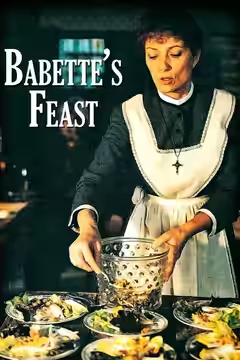
A woman stands in a kitchen on the Danish coast and watches two old sisters make ale-bread soup. She does not speak, and she will say almost nothing for an hour. When she has learned the recipe she goes off to haggle with the fishmonger in a Danish she has picked up on her own. This is how Gabriel Axel directs: he withholds, plainly and for a long time, and then he gives. Babette's Feast (1987) keeps its people in muted rooms eating plain food for most of its length, then sits them down to dinner, and the dinner is as good a stretch about eating as we have seen.
The career behind that film is long and mostly modest. Axel trained as an actor at the Royal Danish Theatre, worked on the Paris stage under Louis Jouvet, and came home in 1950 to direct television, around forty-eight dramas by 1968. His feature debut, Nothing But Trouble (1955), was a social-realist piece and well received; what followed was largely comedy and farce. The Red Mantle (1967), a Nordic saga shot in Icelandic landscapes, was the one earlier film to travel. Then a decade in French television, and then the Blixen adaptation he had wanted to make for years.
He said of Jouvet that "the story was supreme, and that the director's hand should be so invisible as never to distract from the story line," and Babette's Feast is the proof he meant it. He adapted the story with Annemarie Aaes and kept its shape, changing only what the screen needed. He mixed Danish, Swedish and French actors and let Stéphane Audran carry fourteen years in how she holds a basket and looks at a pot. We were overwhelmed by the dinner, more than we expected to be by a film about people who disapprove of pleasure, and the reason is simple: Axel makes us go without alongside the sisters for so long that food arriving at a table feels like a rescue.
The method has costs. The first forty minutes lean on narration and are content to tell us things. Prince of Jutland (1994), his retelling of the Amleth legend with Helen Mirren, Gabriel Byrne and Christian Bale, has the same restraint without the release: a deliberate, dispassionate chronicle, sparsely shot, that waits for a feast that never comes. Leïla (2001) made little impression anywhere. Danish critics were cooler about Babette's Feast than the rest of the world, on the grounds that nothing in his earlier work had predicted it. They had a point, and it is not a point against the film.
Start with Babette's Feast; there is no need to work through the farces first, and the later films are for the curious. A hand this invisible risks disappearing altogether, and for thirty years it more or less did. Once, it set a table.
Biography
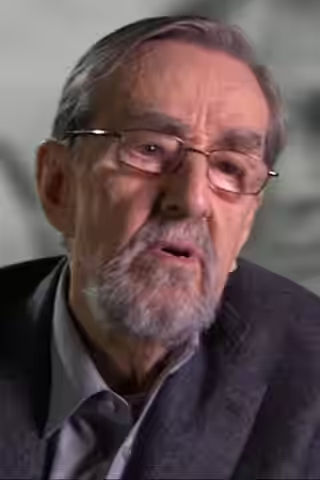
Gabriel Axel was a Danish film director, actor, writer and producer. Born in Aarhus in 1918, he spent much of his childhood in Paris before training at the acting school of the Royal Danish Theatre in Copenhagen.
He began directing for Danish television in 1951 and went on to make numerous feature films and television productions in Denmark and France. Axel is best known for writing and directing Babette's Feast (1987), an adaptation of the Karen Blixen story that won the Academy Award for Best Foreign Language Film.
His other credits include Prince of Jutland (1994) and a segment of Lumière & Company (1995). He remained active until the early 2000s.