Gabriel Range makes fiction that looks like reportage: fake documentaries about events that never happened, and true stories told with a journalist's tidiness. The first mode is where he is sharpest. The second, on our evidence, is careful to the point of timidity.
Fi1m perspective
Gabriel Range's camera behaves as if it were really there. The Day Britain Stopped (2003) and Death of a President (2006) are documentaries about things that had not happened, built from real archive footage cut together with staged interviews, the talking heads sat where talking heads sit and the invention kept entirely to what they say. He came to film from journalism, and the frame has a reporter's steadiness about it. Death of a President, a fictional account of the aftermath of a presidential assassination, was made to provoke, and Range has said as much. It did.
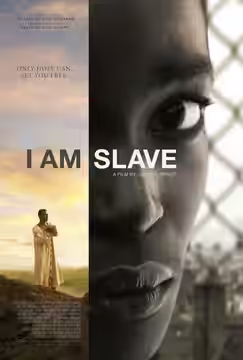
Then the subjects became real people, and something in him tightened. I Am Slave (2010), written by Jeremy Brock, follows a Sudanese woman from the Nuba Mountains to a London house where she is kept as a domestic slave, and it does it in a lean 82 minutes with Wunmi Mosaku holding the whole thing up. It is well shot and it is decent, and we wanted it to be harder than decent. There is a scene in which Malia is left alone in a hall a few feet from an open front door. We were angry, properly angry, as the film meant us to be, and then we were annoyed at the film for cutting away so fast, as if it did not trust us to have understood. The director who had been accused of recklessness over Death of a President had become cautious to a fault.
The biographical work that followed has stayed in that register. Outlaw Prophet: Warren Jeffs (2014), a television film about the rise and crimes of the FLDS leader, and Stardust (2020), co-written with Christopher Bell and following David Bowie on a 1971 trip to America on the way to inventing Ziggy Stardust, both drew notices that found them conventional, and Stardust was received badly. We have not reviewed either, so we will not pile on. We will note that Range cast a musician, Johnny Flynn, and said the aim was "creating a feeling rather than an impression of David", which is an honest account of a difficulty rather than a solution to it.
The thread through all of it is a person inside a system that owns them: a country inside a crisis, a woman inside a house, a flock inside a prophet, a singer inside a persona. When the people are invented and the system is the point, Range is free to be blunt, and bluntness suits him. When the person is real he handles them with a care that reads on screen as hesitation, explaining what he has already shown in case we missed it. We never miss it. He has kept working in drama-documentary and biography into the 2020s. On the evidence so far, we would rather he made up another catastrophe.
Biography
Gabriel Range is a British film director and writer. He began his career in journalism before moving into documentaries and docudramas.
Range wrote and directed the 2003 television film The Day Britain Stopped, for which he received a BAFTA TV Craft Award nomination for Best New Director (Fiction) and won a Royal Television Society Craft and Design Award. His 2006 feature Death of a President, a fictional account of the assassination of George W. Bush, premiered at the Toronto International Film Festival and won awards including the FIPRESCI International Critics' Prize and an International Emmy. He directed the 2010 Channel 4 television film I Am Slave, based on the experiences of Mende Nazer.
Later credits include directing the 2014 television film Outlaw Prophet: Warren Jeffs and the 2020 feature Stardust.