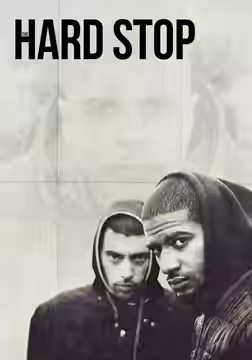
George Amponsah makes documentaries by staying put. He follows people for years, sits in their cars and kitchens, and lets them talk until the story arrives. The Hard Stop shows what that patience buys, and what it leaves off screen.
Fi1m perspective
In The Hard Stop (2016), Marcus Knox Hooke and Kurtis Henville are filmed in cars, kitchens and corridors, and the camera does not push. Marcus is waiting to be sentenced for his part in the night the riots began. Kurtis has children to feed and no job, and the film gives his search for one as much time as it gives the archive of Tottenham burning. We found that harder to watch than any of the riot footage, because the riots are archive and Kurtis is right in front of us, asking. Amponsah's method is to wait for moments like that, and the writing he and Dionne Walker have done is mostly a matter of not interrupting them.
He came to it slowly. He started with photography and Super 8 in the 1980s, came through the National Film and Television School around 2000, and spent the following years in television documentary: The Importance of Being Elegant (2004), co-directed with Cosima Spender, on Congolese sapeurs and the singer Papa Wemba; The Fighting Spirit (2007), following young boxers in Ghana. The subjects change and the approach does not. He picks people the papers have already decided about and stays long enough to see them differently. The Hard Stop is where that approach became a feature and got him noticed.
The trust is the achievement. You cannot fake years of access, and the film's best scenes exist because two men on Broadwater Farm let a camera into their lives at the worst possible time. The weakness is the other side of the same coin. A film built on one side's confidence does not get the other side on screen: the Metropolitan Police appear only as archive and inquest, nobody from the force speaks, and we said in our review that a film asking us to doubt a shooting should put the official account on screen and take it apart. Few women speak, in a film about an estate full of them. Amponsah has said that "the emotional investment is in the edit", and it is. So is the imbalance.
Since then he has mostly worked for television, with Dope (2018), Enslaved (2020) and Black Power: A British Story of Resistance (2021), the last with Steve McQueen among its executive producers. Then came Gassed Up (2023), his first fiction feature, about a member of a London moped gang. The reviews found it leaning on familiar crime-drama shapes; we have not reviewed it and will not judge it here. The open question is whether a filmmaker whose gift is waiting can do his best work in a form that will not wait for anyone.
For tonight, our advice is still The Hard Stop, with the understanding that it will tell you what two men thought and almost nothing about what the police said.
Biography
George Amponsah is a British film director of Ghanaian parentage. Born in Roehampton, London, in 1968, he began working with photography and Super 8 film in the 1980s. He studied at the University of East London and graduated from the National Film and Television School in 2000, where he later taught documentary filmmaking.
Amponsah is best known for the documentary The Hard Stop (2015), which he directed, wrote and produced with Dionne Walker. The film follows two childhood friends of Mark Duggan after his death in a police shooting in 2011 and received a BAFTA nomination for Outstanding Debut by a British Writer, Director or Producer. His other documentaries include The Importance of Being Elegant (2004) and The Fighting Spirit (2007). In 2023 he directed his first drama feature, Gassed Up.