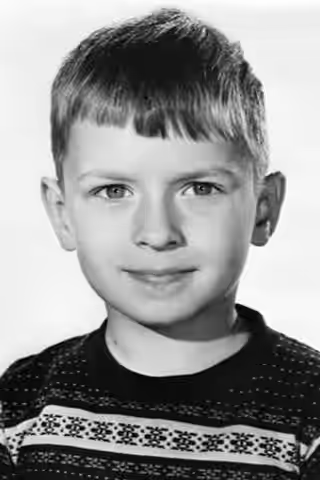
George Winslow's gravelly voice gave a child's cheek an oddly adult authority. We rate his quiet comic timing, especially opposite Marilyn Monroe, while recognising that the novelty could only take a performance so far.
Fi1m perspective
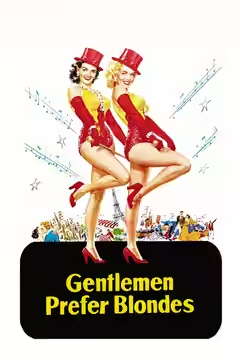
George Winslow opens his mouth and the voice seems to belong to somebody considerably older. Deep and raspy, it gives his small, precocious characters an authority they have done nothing to earn. In Gentlemen Prefer Blondes (1953), his Henry Spofford III needs little fuss to make an impression beside Marilyn Monroe. We laughed at their shipboard exchange because he delivers the cheek with such composure, leaving the peculiar voice to do its work. The timing matters as much as the sound: he does not need to underline the joke.
The early films put that contrast to practical use. Norman Taurog's Room for One More (1952) introduced him in family comedy, and Howard Hawks's Monkey Business (1952) placed him alongside Cary Grant. Mister Scoutmaster (1953) gave him Clifton Webb to trade barbs with and the billing 'Foghorn', which rather told audiences what to listen for. These were useful settings for a child who could answer an adult without sounding eager to please. They also established a fairly narrow expectation of what he would do.
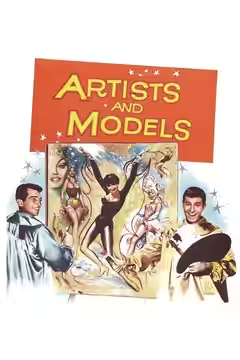
Frank Tashlin's Artists and Models (1955) gives him a small role as Richard Stilton, in a comedy driven by Dean Martin and Jerry Lewis. We like the film's colour and comic-strip mischief, and Shirley MacLaine is a stronger reason to watch than Winslow's brief contribution. The less successful routines go on too long, a warning against mistaking a reliable comic effect for an inexhaustible one. Winslow's voice presents a similar risk: once its oddness has registered, there still needs to be a joke.
He deserves credit for knowing how little emphasis an impertinent line needs. The 'Foghorn' billing encourages us to anticipate a noise, which is a limited advertisement for someone who can be funny by doing so little. His final screen appearance came in Wild Heritage (1958), leaving a short run of childhood roles and no adult performances to reconsider. Start with Gentlemen Prefer Blondes, forgiving its tiresome plotting for Monroe and Jane Russell, and listen to how calmly Winslow holds up his side of the conversation.
Biography
George Winslow, born George Karl Wentzlaff, was an American child actor active in the 1950s. He appeared in films including Room for One More (1952), Monkey Business (1952), Gentlemen Prefer Blondes (1953) as Henry Spofford III, Mister Scoutmaster (1953) and Artists and Models (1955). He was also credited as George 'Foghorn' Winslow and began his career with appearances on Art Linkletter's radio programme People Are Funny.
Winslow retired from acting at around the age of 12. He later served in the US Navy during the Vietnam War and worked for the Postal Service in Northern California. He died on 13 June 2015 in Camp Meeker, California.