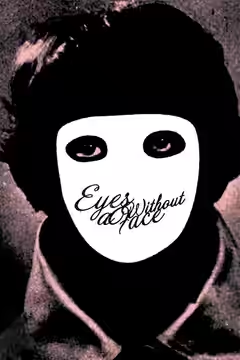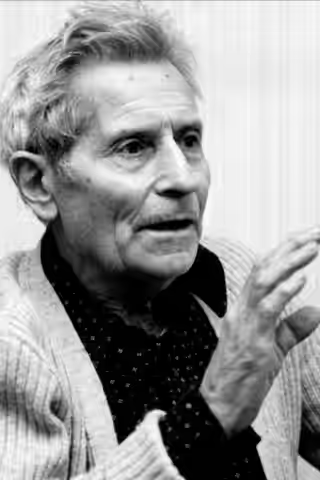
Georges Franju finds horror in ordinary procedures and gives the victims time to matter. We rate him for that compassion, and for images that unsettle without fuss, though his patience can sometimes become sluggishness.
Fi1m perspective
Édith Scob’s mask holds our attention in Eyes Without a Face (1960), but Franju gives us time to think about the woman wearing it. Christiane Génessier’s loneliness matters as much as the facial surgery. We wanted to look away from the surgery because he gives it such sustained attention. He then asks us to stay with Christiane, rather than recover and wait for the next fright. That concern for her makes this an unusually affecting horror film.
The attention to procedures was there in Blood of the Beasts (1949), his short documentary about a Paris slaughterhouse. His first fiction feature, Head Against the Wall (1959), moved into a psychiatric institution. These settings help explain why his horror feels so matter-of-fact: the alarming things happen in places where somebody is doing a job. With Judex (1963), his homage to Louis Feuillade’s silent serials, masks and chases brought that strangeness into a different kind of entertainment.
His regular collaborators included cinematographers Eugen Schüfftan and Marcel Fradetal, editor Gilbert Natot and composer Maurice Jarre. The stark black-and-white contrasts and precise framing make the strange sights easy to see; Franju does not need to obscure them to make them troubling. Scob, who also appears in Judex, is especially important to this restraint. In Eyes Without a Face, the mask gives us little to read, yet she makes Christiane’s isolation felt.
The weakness is the time he takes. In Eyes Without a Face, the deliberate pace occasionally becomes sluggish, and a few passages ask for more patience than they repay. For most of the film, though, the attention to Christiane justifies staying with her. Start there if a horror film willing to spend time on loneliness sounds like an evening worth having.
Biography
Georges Franju (1912–1987) was a French film director. Born in Fougères, Ille-et-Vilaine, he held various jobs before studying theatre design and creating backdrops for Paris music halls. He served briefly in the military in Algeria and was discharged in 1932.
In the mid-1930s, Franju met Henri Langlois through his twin brother. Together they made the short film Le Métro and founded the Cinémathèque Française in 1936. Franju later directed a series of documentaries, including Blood of the Beasts (1949). He turned to fiction features with Head Against the Wall (1959) and Eyes Without a Face (1960), followed by Judex (1963).