A stage magician who bought a camera and found it could do tricks his theatre could not. For fifteen years he made the tricks the point, and the best of them still get a laugh. The camera, though, never moved.
Fi1m perspective
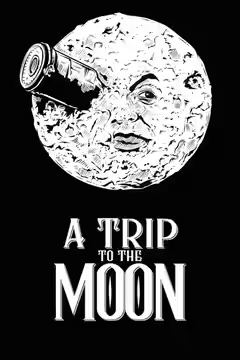
The camera stops. Somebody on the stage shifts, or is swapped for something else, and the camera starts again, and on the screen the change happens between one frame and the next. That is Méliès's whole method, from Escamotage d'une dame chez Robert-Houdin (1896), where he first made a woman vanish on film, to A Trip to the Moon (1902), where a shell fired from a cannon lands in the Moon's eye. He was a stage magician before he was anything else, at the Théâtre Robert-Houdin in Paris, and he treated the camera as a new trapdoor.
He saw the Lumière Cinématographe at the end of 1895, was showing his own films at his theatre by April 1896, and built the first French film studio at Montreuil in 1897. Roughly five hundred films followed between 1896 and 1912, most of them minutes long, the best of them made between 1901 and 1904: A Trip to the Moon, then The Impossible Voyage (1904), which took the same voyage idea further with bigger sets and more machinery. He wrote them, directed them, designed them, cut them and appeared in them. The producer's credit, which is the one we hold him under, is barely a separate job; it is the man who owned the studio and the camera and the beard.
What survives is the design and the timing. The astronomers' hall in A Trip to the Moon has a telescope painted on the wall, the cannon runs off the edge of the set, and the Moon is his own face. We laughed out loud when the shell hit it in the eye, a hundred and twenty years on, and the reason is simple: he holds the face just long enough for us to see the eye blink first. The hand-painted colour prints, done frame by frame, are the ones to see. He had regular hands around him: Théophile Michault and Lucien Tainguy operated the camera, Jehanne d'Alcy appeared in some twenty of the films, and his brother Gaston ran the American side of Star Film.
The camera does not move. Every scene is one wide shot from the middle of the stalls, the actors facing front, and a film is a row of these painted tableaux joined by dissolves rather than a story that develops from one scene to the next. In A Trip to the Moon the six astronomers are six beards and six hats. This was the method and he never changed it. By 1910 other people were cutting between rooms and putting the camera in close, and audiences wanted an hour of story rather than a quarter of an hour of tricks. Méliès made a few films to order for Pathé and stopped in 1912.
"The demon of invention tormented me," he said later, and it is a fair account: he invented the trick and then kept doing it. Watch A Trip to the Moon in colour, all fifteen minutes of it, and then perhaps one of the short conjuring films from the 1890s. Do not sit through a dozen in a row. The tricks are wonderful once each.
Biography
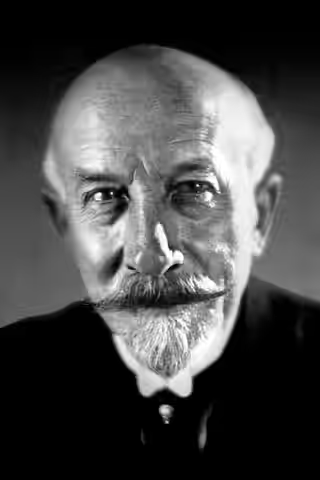
Georges Méliès was a French filmmaker and illusionist. Born in Paris in 1861, he trained as a magician and managed the Théâtre Robert-Houdin before turning to cinema after seeing the Lumière brothers' films in 1895.
He directed, wrote, produced, designed, and edited numerous short films, often appearing in them. His best-known work is the science-fiction film A Trip to the Moon (1902), in which he also played the lead role of Professor Barbenfouillis. Other notable films include The Impossible Voyage (1904) and Le manoir du diable (1896). Méliès made hundreds of films between the mid-1890s and the early 1910s, pioneering techniques such as substitution splicing and multiple exposures.
He retired from filmmaking around 1913. Méliès died in Paris in 1938.