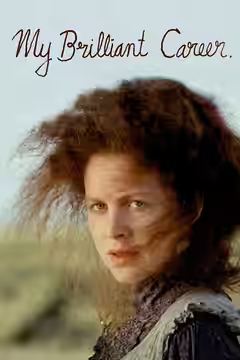
Gillian Armstrong makes films about women who want more than they are offered, and she lets an actor's face finish the scene rather than a line. My Brilliant Career is still the one to start with.
Fi1m perspective
In My Brilliant Career (1979), Judy Davis and Sam Neill start a pillow fight that turns into a chase through the house and out across the lawn, and when it stops the camera stays on Davis while she works out that she is enjoying herself more than she meant to. That is Gillian Armstrong's method: put a capable actor in a corner, give her something to decide, and do not help. We laughed at the chase and went quiet at the face, and it is the quiet we remember.
It was her first feature, made after short films and the documentary Smokes & Lollies (1976), and the first Australian feature directed by a woman in 46 years. Eleanor Witcombe adapted Miles Franklin's novel, and the film takes a young woman's doubts about marriage seriously without punishing her for them. Then she declined to repeat herself: the rock musical Starstruck (1982), a first Hollywood picture in Mrs Soffel (1984), then home for High Tide (1987) and The Last Days of Chez Nous (1992). Little Women (1994) is the one most people have seen. The reviews for Charlotte Gray (2001) and Death Defying Acts (2007) were cooler.
What she does well is cast and then trust the cast. Davis was almost unknown in 1979 and looks in every frame as if she knows exactly what she is doing; Winona Ryder and Kirsten Dunst in Little Women were early chances that paid off. She keeps the same people: Nicholas Beauman has cut many of her features, Geoffrey Simpson shot Little Women and Chez Nous, and Luciana Arrighi, who dressed and designed My Brilliant Career, came back for Mrs Soffel. Donald McAlpine's photography on the first film is handsome without being smug about it. Critics have counted her pianos, gates, oranges and snow; what we notice is that the rooms always look lived in.
The label arrived early and she has spent forty years pushing it off. "I got branded as a feminist director because it was a feminist story, but then that's all I was offered: women achievers," she said in 2016, and the men in her films bear her out. Neill's Harry Beecham is rich, decent and quiet, a man puzzled to find himself asking for something, and he is written with as much care as the woman he is asking.
Meanwhile she has gone back to three working-class girls she first filmed at 14 in Smokes & Lollies and followed them across five films to Love, Lust & Lies (2010). That is a director who wants to know what happens next, which is the question at the end of the pillow fight. Start with My Brilliant Career; it sags for a quarter of an hour in a farmhouse, and it has a lead performance that has not dated by a day.
Biography
Gillian Armstrong is an Australian film director. Born on 18 December 1950 in Melbourne, she studied at Swinburne Technical College and was among the first graduates of the Australian Film and Television School in 1973.
Her debut feature, My Brilliant Career (1979), an adaptation of the Miles Franklin novel, was the first Australian feature directed by a woman in nearly five decades. It won six Australian Film Institute awards, including Best Director. Armstrong went on to direct Mrs Soffel (1984), High Tide (1987), The Last Days of Chez Nous (1992), Little Women (1994), Oscar and Lucinda (1997) and Charlotte Gray (2001). She has also made documentaries, including the series beginning with Smokes and Lollies (1976).
Armstrong is a Member of the Order of Australia and holds several honorary doctorates.