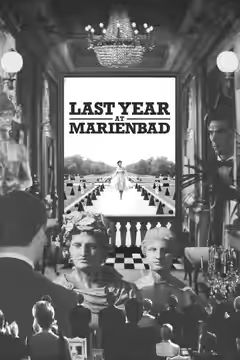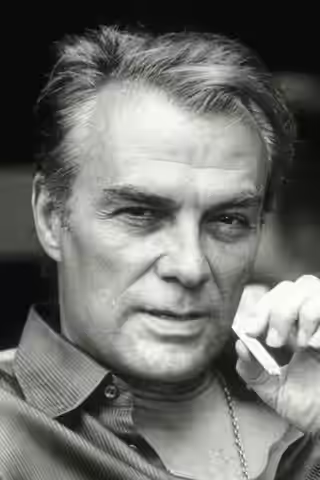
A stage actor who made one film that matters, and made it with his voice: Giorgio Albertazzi's murmuring, insisting X is the reason Last Year at Marienbad holds together, and a good part of the reason it stays so cold.
Fi1m perspective
Start with the voice, because that is what he left us. In Last Year at Marienbad (1961) Giorgio Albertazzi is on screen for most of the film's 95 minutes and does almost nothing with his body that the statues in the garden could not do. He talks. He describes the corridors, the ceilings, the silence, and the year that has passed since he and Delphine Seyrig's A first met, in a low murmur that never rises, while Sacha Vierny's camera glides down the very corridors he is describing as if taking dictation. She says none of it happened. He says it again. The accent, which the credits make part of his character's name, turns each sentence into something recited rather than remembered, and that is the film's whole method in one performance.
He was a stage actor before it and a stage actor after it, and the film was a visit rather than a move. He made his professional debut in 1949 in Luchino Visconti's Troilus and Cressida, formed a company with Anna Proclemer in 1956, and had already been Prince Myshkin in a six-part Italian television The Idiot (1959) when Resnais cast him. What followed on screen was thin: an uncredited part in Joseph Losey's Eva (1962), The Assassination of Trotsky (1972) for the same director, a Jekyll (1969) for Italian television that he adapted and directed as well as played, and one feature of his own, Gradiva (1970). The stage got the rest: Hamlet for Franco Zeffirelli at the Old Vic in 1964, and from 1989 Maurizio Scaparro's one-man Memoirs of Hadrian, which he played close to a thousand times and was still playing at 90.
The complaint made about him is that he acted for the stalls rather than the lens, and it is fair as far as it goes. It is also why Marienbad works. Resnais wanted poses held for exactly as long as the shot needed and a voice that could carry a film without ever seeming to feel what it said; that is a stage discipline, and Albertazzi had it in a way a more naturalistic actor would have spoiled by trying to be sincere. We found, going back to it, that the voice was the frightening thing. It never doubts itself for a second, and somewhere past the hour we stopped asking whether A remembered him and started wondering what he would do if she never did, which is a colder question and, we suspect, the one Resnais wanted us to ask.
The same stillness would have dated fast in ordinary films, and outside Resnais he was mostly given ordinary films, or small parts in them. For anyone curious about him there is one screen performance to see, and it is in a good film. The rest of the work happened in rooms with an audience in them, and those rooms keep no copy.
Biography
Giorgio Albertazzi was an Italian actor and director. Born in Fiesole in 1923, he made his professional stage debut in 1949 in Luchino Visconti’s production of Troilus and Cressida. He became a prominent figure in Italian theatre, performing in many classical and Shakespearean roles, including the title part in Hamlet at the Old Vic in 1964.
His most prominent film appearance was as X in Alain Resnais’s Last Year at Marienbad (1961). He also appeared in White Nights (1957), Eva (1962) and The Assassination of Trotsky (1972). Albertazzi directed several television productions, including the miniseries Jekyll (1969), and died in 2016.